Educating the Public on Evidence-based methods for improving inter-group civility.

How Deeply Ingrained in our Heads is Partisan Affect?

Polarization of American partisans continues to increase.  Liberals and conservatives alike have obvious contempt for opposing partisans — this is universally demonstrated by implicit, explicit and behavioral indicators.  Shanto Iyengar and Sean Westood of Stanford University and Princeton University, respectively, designed a set of four studies — titled “Fear and Loathing Across Party Lines: New Evidence on Group Polarization” to further investigate political dichotomy in America.

1. What They Did – Intervention Summary:

Study 1 assessed implicit partisan affect and anchored it to implicit racial affect. used two different brief versions of the Implicit Association Test (IAT) to measure implicit racial affect and implicit partisan affect.

Participants first completed four rounds of a BIAT created by the researchers to measure their implicit attitudes.  Their “D-scores” were calculated by subtracting their mean response times when pairing a Democratic mascot with “good”.  Positive D-scores (between 0 and 2) indicated greater positive affect for Republicans and inverse responses times indicated greater positive affect for Democrats.

To further validate the tests, the relationship between partisan D-score and a difference in feeling (regarding Democrats and Republicans) thermometer test was examined.

Finally, participants’ scores on the partisan BIAT and the race BIAT were compared.

2. What They Found – Results:

As was expected, they found that partisan D-scores corresponded closely with which party a participant self-identified with.  “Strong Republicans”, for example, produced the most bias in favor of Republicans.

The thermometer test validation, despite a small amount of divergence, correlated strongly (r=.418) with the D-scores.

Racial affect BIATs showed a substantial black-white implicit bias, but the race effect size was not nearly as strong as the party effect size.  When compared to party BIATs, it was discovered that negative associations of opposing parties are faster which, in this case, means more automatic and/or stronger, than negative associations of African Americans.

This tells us that, since racial identity is, obviously, acquired at or before birth and racial attitudes are deeply ingrained, for partisanship to exceed race, its underlying hostility must be immense.

Um ein Online-Pokerspieler zu werden und zu spielen, müssen Sie einige Schritte ausführen. Für Ihre Bequemlichkeit haben wir unten eine schrittweise Anleitung vorbereitet.

Einen Pokerraum wählen. Schauen Sie sich die aktuellen Angebote von Online-Pokerseiten an. Sie können im Internet an verschiedenen Standorten und in verschiedenen Casinos Poker spielen, z. B. unter https://windblowcasino.name/. Erfahren Sie mehr über die Flaggschiffe der Branche, analysieren Sie deren Vor- und Nachteile, lesen Sie die Bewertungen der Benutzer, die Verfügbarkeit einer mobilen Anwendung usw. Versuchen Sie im Allgemeinen, wertvolle Informationen für sich selbst zu erhalten, bevor Sie sich für einen Pokerraum entscheiden. Die beste Option zum ersten Mal ist der Pokerdom-Raum, zumindest aus dem Grund, dass das Rubelspiel hier verfügbar ist. Sie können sich registrieren, indem Sie dem Link folgen.

Sobald Sie sich für einen Pokerraum entschieden haben, der zu Ihnen passt, müssen Sie Ihr Konto bei ihm registrieren. Gleichzeitig empfehlen wir bei der Registrierung die Eingabe eines speziellen Promo-Codes, um noch mehr Boni für weitere Online-Pokerspiele zu erhalten.

3. Who Was Studied – Sample:

SSI

*In order to capture racial affect among non-whites, African Americans were oversampled.

4. Study Name:

Iyenger and Westwood et al. 2014, Study 1

5. Citation:

Iyengar, Shanto & Westwood, Sean J. (2014).  Fear and loathing across party lines: New evidence on group polarization. http://pcl.stanford.edu/research/2014/iyengar-ajps-group-polarization.pdf

6. Link:

http://pcl.stanford.edu/research/2014/iyengar-ajps-group-polarization.pdf

7. Intervention Categories:

Observation

8. Sample Size:

2,000

9. Central Reported Statistic:

“The spread between Democrats and Republicans on the partisan D-score was massive… (p<.001).”

10. Effect Size

D(Republican) = .27, D(Democrat) = -.23

 

Read Ahead

Send us Your Academic Papers on Civil Intergroup Relations

Civil Politics exists to help educate the public on evidence based methods to improve inter-group relations, especially those intractable conflicts that have a moral dimension to them, such as the partisanship that paralyzes US politics.  Part of this effort involves compiling all of the existing evidence that may exist in this domain, so that we can more authoritatively bring this evidence to others who are doing the work on the ground.

Evidence can include many things.  It certainly includes empirical research, both in its published and unpublished form.  It includes examples from the news that echo this research, where people talk about what does or does not lead them toward more or less cooperation vs. animosity across groups.  It includes both the empirical study of the effects of programs that focus on improving inter-group dialogue, as well as the lessons that those who run those programs have learned through years of practice.    The basis of psychometrics and crowdsourcing is the aggregation of results across methods, each of which has it’s own sources of error, with the hope that convergent evidence is reached across methods.  It is the same reason that we want to ask multiple people, ideally with diverse tastes, before passing judgment on a new restaurant or movie, and we hope to bring the same thoughtfulness to the evidence that we present on improving intergroup relations.  The links in this paragraph are examples of how we support the collection and dissemination of each of these types of evidence.

We are currently working on projects that aim to be more systematic about evidence in each of these categories and we could use your help.  Specifically, if you know of academic research that provides evidence for the role of specific variables in increasing or decreasing inter-group civility, please do use this form to provide us with details.  Before adding any specific papers, you can use this link to check what has already been added to the database.  Questions and comments welcome (email me at ravi at civilpolitics dt org) and feel free to provide as much information as you have, even just filling in the first part about specific papers, as we can have others fill in the rest of the information.

IMG_5692
A group of USC students working on CivilPolitics’ academic database.

Please do feel free to forward this blog post to anyone who does research bearing on this question or who knows of such research.  We are also happy to acknowledge your contribution publicly and/or to provide rewards to students who contribute to this project (e.g. travel support to academic conferences) to both incentivize participation and hopefully encourage their interest in this domain.  Thank you for your interest and consideration.

In summary:

– Ravi Iyer


Read Ahead

Affirmation’s Effect on Concession During Political Negotiations

1. What They Did – Intervention Summary:

     Participants were paired face-to-face with a real person whom they believed to hold an opposing belief on an issue about which they cared deeply.  These people were, in fact, confederates — they played the role of an adversary and offered arguments and proposals to the study participants. 

Participants were first asked to write an essay either affirming or threatening a source of self-integrity unrelated to the issue at hand.   Upon completion of their essay, each participant was asked to indicate his or her mood on a scale from -3 (extremely negative or unhappy) to +3 (extremely positive or happy).

So now that you know that there is no need for you to invest in casino gaming equipment or rent them, what about online casino software? How does a free casino game help you to play online? The main reason why casino apps are so popular with players is that they are so easy to use. You can download the software straight from your mobile phone and start playing mobile slot games that pay real money via Apps at the comfort of your home. As an added bonus, many mobile games also allow you to play for free for as long as you want.

The participants were given some background material and copy of a proposed abortion bill.  They were told that they would be playing the role of a Democratic Party State Legislator and that they would be matched with someone playing the role of a Republican Party State legislator to debate the bill.  Half the participants had their beliefs affirmed while half had their beliefs threatened.  Within those two groups, half of the participants had salient convictions and half had non-salient convictions.  They then entered a room with their opposing legislator and debated the bill for 10 minutes before self-reporting their mood again.

An evaluation was then performed on the concessions that each person made toward changes in their initial demands.  The number of original stipulations each participant was willing to surrender was accounted for for each set of participants and then compared for the self-affirmed vs. threatened participants.

2. What They Found – Results:

Study 2 discovered important information about the concessions (instances of acceptance of changes to the bill from the initial proposal to the final agreement) made by its participants.

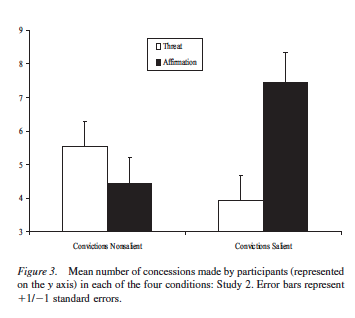
The figure below demonstrates the concession data found in the study.  Most importantly, results show that participants in the self-affirmation condition of the convictions salient section of the study offered more concessions than those in the threat condition.

This means that the participants who had an alternative source of self-integrity affirmed at the beginning of the study found it easier to concede some of their initial demands than the participants who had their self-integrity threatened.

Self-affirmed participants were more likely to see concessions as attempts to find common ground than as hard negotiation and appeared to feel more charitable and willing to compromise.

The participants all had to rate their confederate opposers after the debate and those whose beliefs were affirmed rated their opponents higher than threatened participants did.  So, not only did self-affirmed participants concede more points, but they actually thought more highly of their adversaries.

This demonstrates potential for long-term effects as well, such as for preserving amicable relations.

Figure 3

3. Who Was Studied – Sample:

35 total undergraduate students —29 female and 6 male.

4. Study Name:

Cohen et al. 2007, Study 2

5. Citation:

Cohen, Geoffery L., David K. Sherman, Anthony Bastardi, Lillian Hsu, Michelle McGoey, and Lee Ross. “Bridging the Partisan Divide: Self-Affirmation Reduces Ideological Closed-Mindedness and Inflexibility in Negotiation.” Journal of Personality and Social Psychology 93.3 (2007): 422-24. Ed.stanford.edu. Stanford University. Web.

6. Link

https://ed.stanford.edu/sites/default/files/bridging_divides1.pdf.

7. Intervention Categories:

Contact, perspective

8. Sample Size:

35

9. Central Reported Statistic

“In the case of participants in the convictions salient condition, those in the self-affirmation condition offered more concessions (adj. M 7.43) than those in the threat condition (adj. M 3.94), t(29) 3.28, p .003.”

10. Effect Size:

Self-Affirmation: M = 7.43

Threat: M = 3.94

p = .003


Read Ahead

Living Room Conversations Builds Trust Across Differences Concerning CA Prison Policy

At CivilPolitics, one of our service offerings is to help groups that are doing work connecting individuals who may disagree about political and moral issues.  These disagreements do not necessarily have to be about partisanship.  One organization that we work with is Living Room Conversations, a California based non-profit that holds small gatherings co-hosted by individuals who may disagree about a particular issue, in order to conciously foster non-judgmental sharing about potentially contentious issues.    Below is a description from their website, in addition to a short video.

Living Room Conversations are designed to revitalize the art of conversation among people with diverse views and remind us all of the power and beauty of civil discourse. Living Room Conversations enable people to come together through their social networks, as friends and friends of friends to engage in a self-guided conversation about any chosen issue. Typically conversations have self-identified co-hosts who hold differing views. They may be from different ethnic groups, socio-economic backgrounds or political parties. Each co-host invites two of their friends to join the conversation. Participants follow an easy to use format offering a structure and a set of questions for getting acquainted with each other and with each other’s viewpoints on the topic of the conversation.

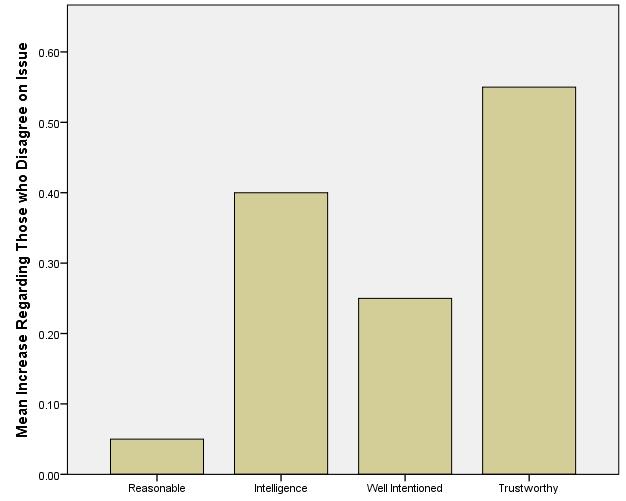
Living Room Conversations is currently holding conversations around the issue of “realignment” in California, which is designed to alleviate prison overcrowding and where many would like to develop alternatives to jail for non-violent criminals.  Living Room Conversations wanted help understanding the effects of their program so we worked with them to develop a survey appropriate for their audience, asking people about their attitudes before and after conversations.  Informed by work in psychology, we looked at how reasonable, intelligent, well-intentioned, and trustworthy people perceived those on the opposite side of the issue to be, compared to how they perceived them before the meeting.  Results, based on a 7-point scale, are plotted below.

LivingRoomConversationsTrust1

The fact that all scores are greater than zero means that people felt that individuals who disagreed with them on these issues were more reasonable, intelligent, well-intentioned, and trustworthy compared to how they felt before the conversation (though with a sample size of only 23 individuals so far, only the increase in trustworthiness is statistically significant).

There was still a stark difference between how people felt about those who disagreed on these issues compared to how they felt about people who they agreed with, as respondents both before and after the event felt that those they agreed with were more likely to be reasonable, intelligent, well-intentioned, and trustworthy.  As well, we asked people about their attitudes about realignment policy and people’s attitudes about the issue didn’t change.  However, civility, as we define it, is not the absence of disagreement, but rather being able to disagree in a civil way that respects the intentions of others.

Moreover, even if people’s minds hadn’t changed with respect to others, individuals felt strongly (8+ on a 10 point scale) that talking with others that hold different views is valuable.  Research on the effects of such positive contact would indicate that if these individuals do follow through on this course, they will likely end up building on these attitudinal gains toward those who disagree.  Given that, these conversations appear to be a step in the right direction.

– Ravi Iyer

Read Ahead
Our goal is to educate the public about social science research on improving inter-group relations across moral divides.