
Educating the Public on Evidence-based methods for improving inter-group civility.

Political Discrimination as Normative as Racial Divisions once were

Once upon a time, it was socially normative for society to divide itself along racial lines.  Thankfully, that time has passed and while racism still exists, it is generally considered to be a bad thing by most people in society.  The same trajectory is occurring with respect to attitudes toward homosexuals, with increased acceptance being not only encouraged, but mandated as the right thing to do.  However, in many circles, it remains normative for individuals to discriminate against those with the opposite political views.  Recent research indicates that this occurs amongst both parties.

Despite ample research linking conservatism to discrimination and liberalism to tolerance, both groups may discriminate. In two studies, we investigated whether conservatives and liberals support discrimination against value violators, and whether liberals’ and conservatives’ values distinctly affect discrimination. Results demonstrated that liberals and conservatives supported discrimination against ideologically dissimilar groups, an effect mediated by perceptions of value violations. Liberals were more likely than conservatives to espouse egalitarianism and universalism, which attenuated their discrimination; whereas the conservatives’ value of traditionalism predicted more discrimination, and their value of self-reliance predicted less discrimination. This suggests liberals and conservatives are equally likely to discriminate against value violators, but liberal values may ameliorate discrimination more than conservative values.

In addition, recent research out of Stanford University indicates that “hostile feelings for the opposing party are ingrained or automatic in voters’ minds, and that affective polarization based on party is just as strong as polarization based on race.”  Tackling this at the societal level is a daunting task for anyone, but there are things that one can do at the individual level.  Both research and practice indicates that positive relationships between individuals across such divides are likely to ameliorate such feelings.  Mixing group boundaries are likely to make competition less salient as well, perhaps allowing superordinate goals that we all share to come to the fore, as often happens when national emergencies strike.  Just as with discrimination based on race and sexual orientation, discrimination against opposing ideologies can be combated with similar techniques.

– Ravi Iyer
 

Read Ahead

Overcoming The Psychological Barriers to Combining Realism with Idealism

I was recently forwarded this thoughtful article by Peter Wehner, from Commentary Magazine, that talks about the need for people to appreciate the importance of idealism in striving for policy goals as well as the realism of compromise with others who also have valid parts of the truth.  From the article:

Politics is an inherently messy business. Moreover, the American founders–who developed the concepts of checks and balances, separation of powers, and all the rest–wanted politics to be messy. …

Too often these days, zealous people who are in a hurry don’t appreciate that the process and methods of politics–the “messy,” muddling through side of politics–is a moral achievement of sorts. But this, too, is only part of the story.

The other part of the story is that justice is often advanced by people who are seized with a moral vision. They don’t much care about the prosaic side of governing; they simply want society to be better, more decent, and more respectful of human dignity. So yes, it’s important not to make the perfect the enemy of the good. But it’s also the case that politics requires us to strive for certain (unattainable) ideals….

What happens all too often in our politics is that people who are drawn to one tend to look with disdain on those who are drawn to the other. What we need, I think, is greater recognition that both are necessary, that each one alone is insufficient. Visionaries have to find a way to give their vision concrete expression, which requires deal-making, compromise, and accepting something less than the ideal. Legislators need to govern with some commitment to philosophical and moral ideals; otherwise, they’re just passing laws and cutting deals for their own sake.

Unfortunately, moral conviction is often negatively correlated with appreciating the need for compromise.  How then can we combine realism with idealism?  We here at CivilPolitics are actively supporting research to help understand how to remove these barriers to groups coming together despite moral disagreements and welcome contributions from academics who have good ideas.  Some ideas that have support in the research include improving the personal relationships between groups and introducing super-ordinate goals where moral agreement can occur.  In future months, we’ll be highlighting other recommendations along these lines to help combine realism with idealism.

– Ravi Iyer


Read Ahead

CivilPolitics.org comments on Hollande’s Political Strategy for BBC World

Earlier today, I appeared on BBC World’s Business Edition to comment on Francois Hollande’s efforts to unite union and business interests in working to improve the lagging French economy.  I provided the same advice that I often do to groups that are looking to leverage the more robust findings from social science in conflict resolution, specifically that rational arguments only get you so far and that real progress is often made when our emotions are pushing us toward progress, as opposed to working against us.  Accordingly, it often is better to try to get the relationships working first, in the hopes that that opens minds for agreement on factual issues.  As well, it is often helpful to emphasize super-ordinate goals, such as improving the economy as a whole in this case, as opposed to competitive goals such as hiring mandates.  Lastly, hopefully Hollande, as a socialist who is fighting for business interests, can help muddy the group boundaries that can make conflicts more intractable, providing an example of someone who is indeed focused on shared goals.

Below is the segment, and my appearance is about 2 minutes into the video.

– Ravi Iyer

Read Ahead

Pew Research highlights Social, Political and Moral Polarization among Partisans, but more people are still Moderates

A recent research study by Pew highlights societal trends that have a lot of people worried about the future of our country.  While many people have highlighted the political polarization that exists and others have pointed to the social and psychological trends underlying that polarization, Pew’s research report is unique for the scope of findings across political, social, and moral attitudes.  Some of the highlights of the report include:

  • Based on a scale of 10 political attitude questions, such as a binary choice between the statements “Government is almost always wasteful and inefficient” and  “Government often does a better job than people give it credit for”, the median Democrat and median Republicans’ attitudes are further apart than 2004 and 1994.
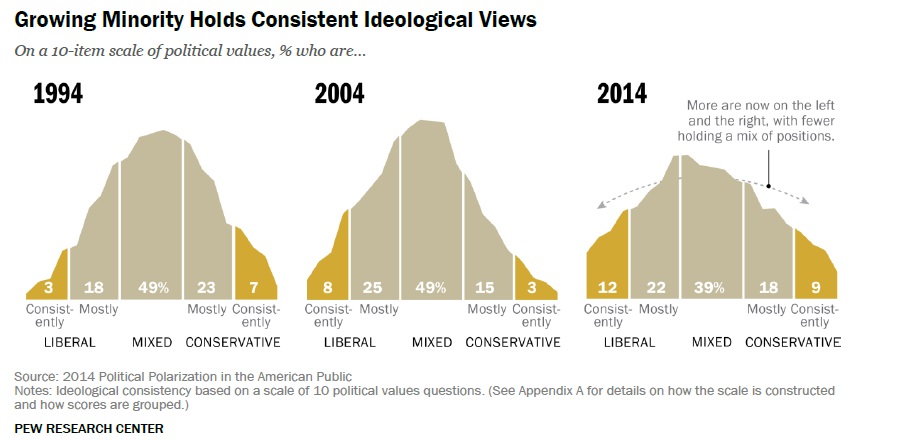
  • On the above ideological survey, fewer people, whether Democrat, Republican, or independent, are in the middle compared to 1994 and 2004.  Though it is still worth noting that a plurality, 39% are in the middle fifth of the survey.
  • More people on each side see the opposing group as a “threat to the nation’s well being”.
  • Those on the extreme left or on the extreme right are on the ideological survey are more likely to have close friends with and live in a community with people who agree with them.


The study is an important snapshot of current society and clearly illustrates that polarization is getting worse, with the social and moral consequences that moral psychology research would predict when attitudes become moralized.  That being said, I think it is important not to lose sight of the below graph from their study.


Pew Survey Shows a Shrinking Plurality holds Moderate Views


Specifically, while there certainly is a trend toward moralization and partisanship, the majority of people are in the middle of the above distributions of political attitudes and hold  mixed opinions about political attitudes.  It is important that those of us who study polarization don’t exacerbate perceived differences, as research has shown that perceptions of differences can become reality.  Most Americans (79%!) still fall somewhere between having consistently liberal and consistently conservative attitudes on political issues, according to Pew’s research.  And even amongst those on the ends of this spectrum, 37% of conservatives and 51% of liberals have close friends who disagree with them.  Compromise between parties is still the preference of most of the electorate.  If those of us who hold a mixed set of attitudes can indeed make our views more prominent, thereby reducing the salience of group boundaries, research would suggest that this would indeed mitigate this alarming trend toward social, moral, and political polarization.

– Ravi Iyer

Read Ahead
Our goal is to educate the public about social science research on improving inter-group relations across moral divides.