Earlier today, I appeared on BBC World’s Business Edition to comment on Francois Hollande’s efforts to unite union and business interests in working to improve the lagging French economy. I provided the same advice that I often do to groups that are looking to leverage the more robust findings from social science in conflict resolution, specifically that rational arguments only get you so far and that real progress is often made when our emotions are pushing us toward progress, as opposed to working against us. Accordingly, it often is better to try to get the relationships working first, in the hopes that that opens minds for agreement on factual issues. As well, it is often helpful to emphasize super-ordinate goals, such as improving the economy as a whole in this case, as opposed to competitive goals such as hiring mandates. Lastly, hopefully Hollande, as a socialist who is fighting for business interests, can help muddy the group boundaries that can make conflicts more intractable, providing an example of someone who is indeed focused on shared goals.
Below is the segment, and my appearance is about 2 minutes into the video.
Based on a scale of 10 political attitude questions, such as a binary choice between the statements “Government is almost always wasteful and inefficient” and “Government often does a better job than people give it credit for”, the median Democrat and median Republicans’ attitudes are further apart than 2004 and 1994.
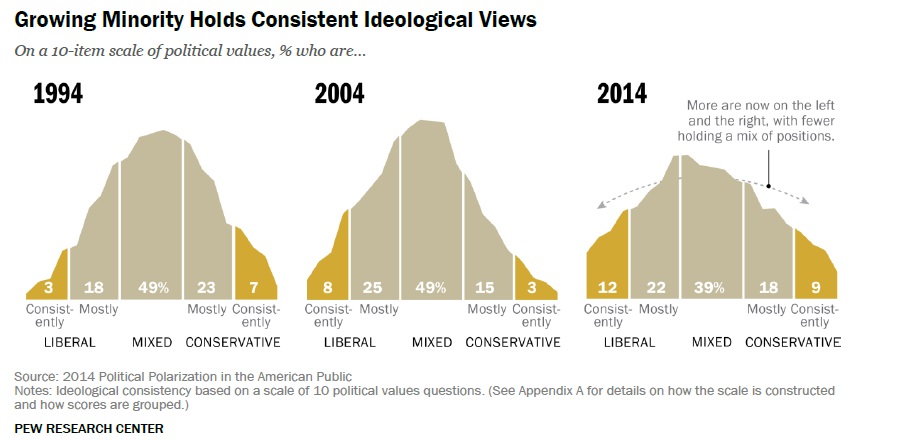
On the above ideological survey, fewer people, whether Democrat, Republican, or independent, are in the middle compared to 1994 and 2004. Though it is still worth noting that a plurality, 39% are in the middle fifth of the survey.
More people on each side see the opposing group as a “threat to the nation’s well being”.
Those on the extreme left or on the extreme right are on the ideological survey are more likely to have close friends with and live in a community with people who agree with them.
The study is an important snapshot of current society and clearly illustrates that polarization is getting worse, with the social and moral consequences that moral psychology research would predict when attitudes become moralized. That being said, I think it is important not to lose sight of the below graph from their study.
Pew Survey Shows a Shrinking Plurality holds Moderate Views
Specifically, while there certainly is a trend toward moralization and partisanship, the majority of people are in the middle of the above distributions of political attitudes and hold mixed opinions about political attitudes. It is important that those of us who study polarization don’t exacerbate perceived differences, as research has shown that perceptions of differences can become reality. Most Americans (79%!) still fall somewhere between having consistently liberal and consistently conservative attitudes on political issues, according to Pew’s research. And even amongst those on the ends of this spectrum, 37% of conservatives and 51% of liberals have close friends who disagree with them. Compromise between parties is still the preference of most of the electorate. If those of us who hold a mixed set of attitudes can indeed make our views more prominent, thereby reducing the salience of group boundaries, research would suggest that this would indeed mitigate this alarming trend toward social, moral, and political polarization.
I recently read with interest the news that several Silicon Valley entrepreneurs are attempting to “fix” political dialogue in this country through a well funded new venture called Brigade Media. From this Time Magazine article:
With backing from early Facebook investor Sean Parker, Brigade Media LLC has already raised an impressive $9.3 million in funds to improve civic engagement from the federal level down to state and local politics
Guided by its scrappy startup ethic, Silicon Valley has disrupted entrenched industries from hotels to rental cars to pizza delivery, but a group of tech barons are raising the stakes with what may be their biggest challenge yet: American democracy.