
Educating the Public on Evidence-based methods for improving inter-group civility.

CivilPolitics Annual Report for 2014

The below text is from our annual report produced for 2013-14. The report is also available via PDF. If you are interested in contributing to Civil Politics or working with us, please contact us.

To Our Stakeholders

Overview

As of the end of 2014, CivilPolitics had been incorporated for roughly 15 months.  In that time, we have made significant progress in terms of both contributing to our collective understanding of moral conflict and defining our organizations’ unique niche within this world, where numerous other organizations already exist that do complimentary work.  In this report, we’ll talk first about what we have done in 2014, including both what has and what has not worked, and then what that has meant as far as defining CP’s niche going forward.  We will then talk about our plans for 2015.

2013-14 in Review

Our organization’s mission is to facilitate the application of evidence-based methods for improving inter-group relationships.  Our methodology for doing this leverages the unique place that we start from, as a group of academics that also have experience with educating the public about research.  The diagram below illustrates how we expect this to occur, with academic research informing those who are attempting to bridge gaps in the real world, but also with information from real world practitioners informing the questions that need more study by academics.

In 2013-14, we have worked with a number of practice partners directly, providing recommendations as to the best practices suggested from our research. Some examples include:

  • The film makers behind Bring It To The Table, which humanizes both sides of the American political divide
  • A2Ethics, which hosts community events designed to illuminate moral issues in non-partisan ways
  • Living Room Conversations, which has been focused on creating events in California where people can civilly discuss issues concerning prison reform
  • The Nathan Cummings Foundation, with whom we hosted an explicitly cross-partisan dialogue
  • The Village Square, which hosts numerous events in the community designed to bring people together to discuss important issues without rancor

For these organizations, we have provided tactical advice on bridging moral divides, based on moral psychology research.  In most of these cases, we have also worked with these organizations to collect data (examples here, here, and here) as to how their work has impacted the people who attend their events.  The results of this data collection has been mixed in that in each case, we have found evidence for the positive effects that these organizations’ events have on attendees, but the difficulties in collecting the data at scale from relatively busy attendees, whether we tried technological or old-school methods, necessarily limited our sample sizes and therefore limits the breadth of conclusions we can make based on this data alone.  Still, we have published several studies based on this work online, with the idea that all evidence has value.

To further take advantage of what academics can learn from real-world practitioners, we have taken what we have learned from these organizations informally, and sought to formalize that process (see example here) so that we can more directly leverage these groups’ experiences.  The hope is that if the results of empirical work with these groups converges with the specific lessons that practitioners have learned intuitively in the everyday course of their work, then we can be even more confident that the methods used by these organizations should indeed be shared with a wider audience.

Ideally, the best evidence-based practices should be supported by both the experience of practitioners and more highly controlled studies done in academic labs.  Both to provide this convergence and to support our work advising organizations and the public, we have spent a lot of time in 2013-14 examining the existing research for the best recommendations that we could make to practitioners.  We also commissioned a study by Professor Jesse Graham at the University of Southern California, where he and his lab reviewed existing research and made their own independent recommendations.  One of the most encouraging signs for CivilPolitics’ path forward is that the results of this independent research were similar to our own findings and also matched what we found in talking with practitioners, and even what the data we collected from practitioners suggested.

Specifically, there are two recommendations that we feel especially confident about: improving personal relationships and emphasizing super-ordinate goals.  Both of these recommendations make intuitive sense to those who are caught up in moral conflicts, yet situations are often setup such that personal relationships across groups are made a secondary concern (e.g. politicians have less time to socialize with each other) and competition is emphasized (e.g. the permanent campaign).  We see a great opportunity in focusing on these two specific recommendations when communicating with both practitioners and the general public.

Early in 2014, we launched a newly designed website and over the course of the year saw a roughly 50% increase in site visitors from approximately ~2000 visitors per month to over 3000/month on average.  Our internet presence is well indexed by search engines, such that we are able to answer many formal and informal requests for information and ideas that can be used by anyone seeking to improve relations in their community.  Based on requests we have received for follow-up information, some number of these site visitors are journalists seeking information to share with others or educators seeking to make an impact in their classrooms, such that the extended impact of the information we provide goes beyond those who explicitly visit our internet presence.  Still, in 2015, we hope to expand our outreach, leveraging the fact that we are more confident in the specific recommendations to offer that have been shown to be evidence-based from numerous perspectives from both academia and the real-world.

Lastly, we continued to publish and support research in this domain at both the applied and basic levels.  Among the published articles we have published in top peer reviewed psychology journals include research showing how moral elevation can reduce prejudice, how cognitive style can illuminate ideological differences, how nature can lead to altruism, how values can shape foreign policy attitudes and how ideology can lead people to geographically separate.  We also commissioned research from graduate students at the University of Virginia to specifically test five separate ideas for improving intergroup relations.  Beyond the work we have directly led or supported, we have continued to maintain our primary research platform, yourmorals.org, which continues to reach hundreds of thousands of visitors each year and educate them as to moral psychology, with an eye toward greater understanding of those we disagree with.  It also collects data that has led to dozens of research publications that inform our understanding of our collective morality.  Building upon this success, we have sought to export this same model of education + data collection to the scientific understanding of religion (at exploringmyreligion.org) in collaboration with the Institute for the Bio-Cultural Study of Religion at Boston University.

Finance and Administration

In 2013-14, Civil Politics incorporated and successfully applied for non-profit status as a 501c(3) charity under the US tax code, with contributions tax deductible.  We received approximately $70,000 in 2013-14 from The Village Square, Reid Hoffman and the Nathan Cummings Foundation, of which we spent $40,000 during this period, primarily on revamping our website, legal/administrative startup costs, technical costs to support YourMorals.org, and contracted research.  As of January 1, 2015, we have approximately $30,000 remaining and expect our budget for 2015 to be lower than 2013-14, given that some of our initial year expenses were one-time expenditures to set up technical and administrative systems.  We expect to be able to maintain our operations going forward with approximately the same level of resources while continuing to improve the ratio of dollars spent per person reached, keeping that well under the cost of a postage stamp, and also continuing to support more published research on evidence-based techniques for improving inter-group relations, whether on our site or in peer-reviewed journals.

Our Niche

In 2015, we would like to build upon what worked in 2013-14 and continue to leverage our unique positioning between academia and the public.  We still plan to offer measurement exercises for partner groups, but will also offer structured interviews that enable partners to share what they have learned systematically.   We will build upon the literature review that we completed in 2014 by finding and/or supporting research that will complement areas that need more research.  We will continue to leverage our platforms at YourMorals.org and CivilPolitics.org  to educate hundreds of thousands of people.  Now that we have more focused, well-supported recommendations to offer, we plan to leverage social media and the press more.  In summary, we plan to continue to spread what we already know about evidence-based methods for improving intergroup relations, while also continuing to support new research in areas where we ought to know more.

– Ravi Iyer
Executive Director
Read Ahead

Hack4Congress Identifies Tech Ideas to improve Cooperation

While there is a lot of research on many variables that increase inter-group civility, a large number of them can be grouped under the general category of improving cooperation/reducing competition (see lit review here).  As such, I was particularly interested to read about #Hack4Congress‘ work that attempted to find technological solutions to improve cooperation.  Among the winning ideas were 2 that specifically related to improving cooperation:

DICO is designed to allow other systems to access and incorporate the information provided by DICO to enhance other institutional processes of Congress through a central database.  Using DICO, a system can identify cross-partisan coalitions that are based on shared interest in particular issues.

The Dear Colleague website is an alternative to the eDear Colleague mailing system currently used by Members of Congress to request other members to co-sign letters, brief them on happenings on the Hill and send voting alerts. As opposed to the current system that functions primarily as a bulk mailing list, our website enables collaborative law making…

You can read more about the winners and contest here.  Social psychology teaches us that the mere desire to cooperate doesn’t always win out over situational barriers.  Improving cooperation may be a stated desire of both parties, but actual cooperation may require the creation of new tools that facilitate a cooperative environment, such as those identified in this project.

– Ravi Iyer

Read Ahead

A2Ethics Mixes Beer with Ethics for Non-Partisan Fun and Civil Debate

CivilPolitics’ mission is to educate the public on evidence-based methods for improving inter-group dialogue, with evidence defined broadly to include academic studiesempirical studies of community interventions, and also the practical wisdom learned by organizations that are bringing people together in the community.  As part of this last area of evidence, we are asking our partners in the community to answer a set of semi-standardized questions designed to help us learn the common themes that run through successful community work.  If you would like to have your organizations’ work profiled, please do contact us and/or fill out this form.  This is the first post in this series,  where Jeanine DeLay, President of A2Ethics.org, shares lessons learned from her organizations’ work.

What is the organization/group that you represent? What is its history in terms of getting involved with improving community relationships?

A2Ethics.org (A2 is a commonly used acronym for Ann Arbor, Michigan), is a nonprofit organization, founded in 2008 to introduce and provide opportunities to talk over community issues through an ethics lens, in addition to or instead of, the usual political and economic lenses characterizing public discussions today.

What specific programs/events/curriculum do you run? Briefly describe what it is you do.

A2Ethics’ signature event is the Big Ethical Question Slam, a competition we made up. The Slam is now celebrating its 5th year–it has become a very popular annual community get-together. In addition, the Slam has appeared in other communities. It hasn’t “gone viral,” but we know of Slams planned for cities in New York, Louisiana and Pennsylvania. And at least one other city has integrated a Big Ethical Question Slam into its community life: Winnipeg, Manitoba. In fact, in 2015, the winner of the Ann Arbor Slam is going to pair off against the winner of the Winnipeg Slam, when A2Ethics and the Manitoba Association of Rights and Liberties, co-sponsor and simulcast the first International Slam-off.

Since our beginnings, A2Ethics has been committed to intergenerational programs, exhibits and events. Further, we do our best to present ethics issues in artful, inventive, open-minded and nonpolarizing ways through collaborations, outreach, and “social weaving” networks.  In November 2013, the Ann Arbor City Council passed the city’s first ever ethics education resolution. This resolution came from efforts by A2Ethics to educate residents about the importance of establishing a basic ethics policy for elected officials in our community. We spearheaded this effort through a series of podcasts called City & Local Ethics.  In February 2014, A2Ethics organized the first Michigan High School Ethics Bowl. Modeled after High School Ethics Bowl competitions in 18 states, the event was co-sponsored with our partners from the University of Michigan Department of Philosophy Outreach Program. The Bowl featured seven student teams from four local high schools who studied and talked over a diverse set of ethics case studies written by local community leaders and professionals.

What has worked well in your programs/events? If someone else wanted to replicate your programs, what specific advice would you give them as far as things to do to replicate your successes?

Recommendations about what has worked well:

1. We try to co-sponsor all of our events and programs with other local organizations. This increases the chance of success–from promotion to participation.

2. With respect to one specific event, The Big Ethical Question Slam, the following practices have been successful:
a. The venue is at an Irish pub. We promote the Slam as a “thinking and drinking” event.

b. The Celtic room (where the Slam is held) only holds 120 people. We believe the intimacy of the room, and the amateur nature of the competition help to make it a welcoming venue for talking about big and controversial subjects. The Slam is also in February–usually a cold night in Michigan. This means only those interested come. We have had the opportunity to move to a larger venue, which would expand the audience, but we have decided to keep it small. We think the attendance limit helps promote civility and convivial discussions too.

c. We try to infuse humor into the evening. Our prizes include a philosopher’s hat–which is really a wizard’s pointy hat (similar to the sorting hat from the Harry Potter stories). The philosopher’s hat is amazingly popular (who knew?); the winning team takes it to their office or school where it is on display for the year. Likewise, the second place team wins a philosopher refrigerator magnet, e.g., Plato, Confucius. These too are strangely coveted. (I don’t want to overdo this!!) Finally, we try to include a few questions (not usually from the public, but ones we make up) that are amusing. An example is one that we took from our friends who created the Winnipeg Slam. They included a series of “zombie” questions the judges had to answer at the end of the competition.

d. Having individuals from nonprofit and for-profit organizations participate as teams brings together people from those organizations to talk about issues they normally wouldn’t discuss. So, the Slam has a team-building function. Second, the organizations competing in the team do not routinely interact. This affords the opportunity to meet people from organizations with different missions and purposes.

e. Audience participation in the Slam, through a scoring card and their role in giving The People’s Choice Award, has had one unexpected benefit. While teams are conferring on a question, the audience members, some of whom do not know the person sitting next to them, are doing the same. We find this to be the most beneficial outcome of the Slam, because the conversations appear to be civil and good- humored.

f. The rules are deliberation rather than debate-oriented. No team gets to respond to the same question. This rule and the fact that teams do not get to rebut or take one position that is, in turn, critiqued by other teams has helped to prevent the event from becoming an occasion for partisan grandstanding and ideological obstinacy. To be sure, this is just a guess!

What have you tried in your progams/events that has NOT worked well? If someone else wanted to replicate your programs, what advice would you give them as far as things to AVOID doing?

I would like to parse this question–and separate what we think has not worked well in our efforts with the Slam from what it we think it is important to avoid. I think we would like to be bolder in our approach. We are not seeking to chill or avoid discussions. First, while the event is intergenerational (which is positive), we would very much like to be more inclusive in our team outreach in order to make the event–and even our questions–more racially, economically and politically diverse. For example, we have done a cursory examination of economist Esther Duflo’s work on the decisions that poor people confront in their daily lives. We wonder what kinds of questions we might receive that would be different? Perhaps none. The point is this: when we get a question such as, whether favela tourism is ethical?–how might those who live in a favela answer?

Second, we would like to encourage more than one night of community discussion when ethics matters–actually matter. Is it easier to be civil for just one night? We would like to know.

Third, we live in a one-party enclave. For example, the city of Ann Arbor is electing a new mayor in 2014. The real race, which was contested, occurred in August when there were four contenders in the Democratic primary. Ann Arbor, like other electoral districts in our country, is increasingly a safe haven for one party. Most significantly, only 16% of the registered voters in Ann Arbor actually voted in the primary. This means that only about 14,000 of 90,000 voters are participating in the decision about who leads the city and sets policies that impact all residents. Why is this important for the Slam and for the organization of events like it? The point is that events such as the Slam can try and increase civility, but is the Slam really doing anything other than reinforcing the beliefs of individuals who are already like-minded? And is it the kind of event that increases not just civility, but strengthens civic engagement–such that more voters are going to the polls? Indeed, will an increase in civility, in turn, increase civic engagement? We are interested in learning about this–and we would like to know if we are confused and conflating issues that are really quite different.

Finally (and related to the previous point), we are very interested in teasing out what makes the event a popular ‘success” in our community from what makes for a civil engagement “success.” We haven’t a clue.

These are all reasons we are very enthused about networking with CivilPolitics.org, learning about and even being a part of the research in which your group is engaged.

Regarding what has not worked well, we offer this list:

Overall, in the Big Ethical Question Slam, we have learned good questions, great judges and informed knowledge about a question topic are critical to the likelihood the event will be considered a community success.

1. Problem questions

a.We do not accept questions about abortion or capital punishment.

b.If there are too many “political” questions in a given evening, there are complaints about the meaning of an ethics question v. a political question. For example, if there are too many questions such as: why shouldn’t we regard the purchase of health care insurance by everyone as a civic duty?–as opposed to–is it ethical for a real estate agent to represent both the buyer and the seller? then participants will let us know afterwards and in our feedback queries.

At the same time, if we mix the two carefully, participants do not object. We have not always done a very good job of comingling. We don’t think it necessary to balance them as journalists often do–that is, to get “two sides.” We think, however, it is very hard to discern what audiences consider “political.” That said, we also think that current political questions (featured in the news), alert the “political police” in our audiences. An example would be a question we had about drones and whether their use was ethical in war. The team receiving that question seemed hesitant to respond. When the team speaker did respond, some in the audience hissed. What to do? We would like to be prepared to respond to this potential reaction in the future.

c.Since we solicit questions from the public, sometimes the questions are poorly worded or barely coherent. We have taken two approaches– editing them, or alternatively, leaving them largely unedited. Everyone agrees that all questions should be edited, and where possible, condensed and shortened.

2. Problem Judges

a. If judges are too opinionated in their comments, the audience balks. If judges, however, offer many sides and assist a team with their knowledge of the subject–sometimes giving a resource–they tend to win the crowd over.

b.If judges disagree with each other, that is just fine. If they become adversarial, they lose the wisdom they are imparting.

c. If judges are taken in by emotional responses, e.g., personal stories of families facing end-of-life issues, the teams will object in the feedback we solicit.

d. If judges are not willing to banter and do not have a sense of humor or some humility, they will not be effective.

3. Lack of Knowledge by Responding Teams

a. From where we sit as Slam organizers, our greatest fear is the amount of misinformation some teams impart about a given topic. For example, some of the questions require technical knowledge. If the team does not know the facts, they just continue to pass on information that is uninformed and inaccurate. If the information is wrong, then it is also difficult to discuss whether it is wrong from an ethics perspective.

b.Simultaneously(and seemingly a contradiction), Slam organizers are concerned about reliance on unsourced “facts”–gleaned in many cases, from the internet. For example, last year, teams began to bring notes to the event. While we applaud their preparation, most of the preparation was cited from unsourced facts–and not on ethics issues embedded in the questions. What to do? We are not sure. We could, for example, suggest some sources for teams to use in their preparations–The Stanford Encyclopedia of Philosophy–comes to mind. That said, the Slam is not a class, it is a community event.

Among the ideas listed on CivilPolitics’ website, based on psychological research, that have been suggested as ways to reduce intergroup divisions. Which of these ideas are reflected in the work you do?  What might you add to these ideas?

Reducing the Perception of “Zero-Sum” competition, (any win for one side = a loss for the other side), Affirming One’s Own Values to make people open to Others, Increasing Cross-Group Personal Connections through Fun, Meals, Talking, etc..

Operationalizing the techniques based on psychological research:

1. Our group is unfamiliar with most of these areas of research. So, we are very interested in learning about them. We can, however, contribute a few thoughts about how we think the Slam does reduce intergroup divisions.

a. Our event is billed as a “thinking and drinking” night. People are coming together for a meal and a beer. Even the judges are invited to have a few beers (sometimes by a team trying to “corrupt” a judge!) Likewise, as mentioned above, we encourage the judges to be sympathetic and good-natured in their “slam” commentaries. For the most part, the judges come through. Our prizes are also fun–from winning the philosopher’s hat to receiving Socrates refrigerator magnets.

c. We also increase personal connections between strangers sitting next to each other through audience score cards. The audience is invited to “judge” the team responses to the questions. After the question is given, there is a time (2 minutes) for conferencing by the teams. After the first Slam, there was some discussion about eliminating this, as the teams get a chance to see the questions a week before the Slam. What we have found is that the audience uses this time to talk with each other about the question to be answered. They discuss their own responses, sometimes with friends, but many times with a stranger, someone who is sitting next to them. It may have the effect of reducing intergroup divisions. We don’t know. We do know that it is that part of the Slam that the audience likes most, through the anecdotal feedback we have received about the event.

b. We wonder whether the check-off “affirming one’s own values to make people open to Others,” applies to the Slam. We think it does-if it means that people who don’t know each other are getting up and publicly proclaiming that they agree with assisted suicide under certain circumstances–or that zoos are ethical. These public declarations about ethics issues posed by the questions are integral to the Slam.

c. The Slam is not a zero sum competition in the sense that no team evaluates another team’s response publicly. They may have ideas they would like to share about how another team responded and what they said. But these are embedded in the conversations that sometimes take place between team members afterwards.

The Slam does NOT, however, give the impression that ethics responses are “just a matter of one’s opinion.” The judges serve to inform participants that there are ethics theories, concepts, techniques and tools that can be very useful and important in responding to the questions raised.

Finally, the organizers hope the Slam gives those attending a sense that they are participating in an event or occasion that actually goes back centuries–when philosophers and the public gathered for a drink and a meal to argue and examine the big ethical questions of their time.

Where can others learn more about what you do?

www.a2ethics.org

Read Ahead

Living Room Conversations Builds Trust Across Differences Concerning CA Prison Policy

At CivilPolitics, one of our service offerings is to help groups that are doing work connecting individuals who may disagree about political and moral issues.  These disagreements do not necessarily have to be about partisanship.  One organization that we work with is Living Room Conversations, a California based non-profit that holds small gatherings co-hosted by individuals who may disagree about a particular issue, in order to conciously foster non-judgmental sharing about potentially contentious issues.    Below is a description from their website, in addition to a short video.

Living Room Conversations are designed to revitalize the art of conversation among people with diverse views and remind us all of the power and beauty of civil discourse. Living Room Conversations enable people to come together through their social networks, as friends and friends of friends to engage in a self-guided conversation about any chosen issue. Typically conversations have self-identified co-hosts who hold differing views. They may be from different ethnic groups, socio-economic backgrounds or political parties. Each co-host invites two of their friends to join the conversation. Participants follow an easy to use format offering a structure and a set of questions for getting acquainted with each other and with each other’s viewpoints on the topic of the conversation.

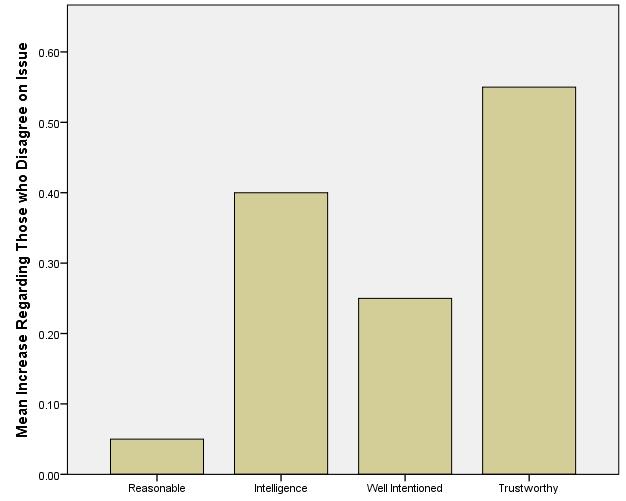
Living Room Conversations is currently holding conversations around the issue of “realignment” in California, which is designed to alleviate prison overcrowding and where many would like to develop alternatives to jail for non-violent criminals.  Living Room Conversations wanted help understanding the effects of their program so we worked with them to develop a survey appropriate for their audience, asking people about their attitudes before and after conversations.  Informed by work in psychology, we looked at how reasonable, intelligent, well-intentioned, and trustworthy people perceived those on the opposite side of the issue to be, compared to how they perceived them before the meeting.  Results, based on a 7-point scale, are plotted below.

LivingRoomConversationsTrust1

The fact that all scores are greater than zero means that people felt that individuals who disagreed with them on these issues were more reasonable, intelligent, well-intentioned, and trustworthy compared to how they felt before the conversation (though with a sample size of only 23 individuals so far, only the increase in trustworthiness is statistically significant).

There was still a stark difference between how people felt about those who disagreed on these issues compared to how they felt about people who they agreed with, as respondents both before and after the event felt that those they agreed with were more likely to be reasonable, intelligent, well-intentioned, and trustworthy.  As well, we asked people about their attitudes about realignment policy and people’s attitudes about the issue didn’t change.  However, civility, as we define it, is not the absence of disagreement, but rather being able to disagree in a civil way that respects the intentions of others.

Moreover, even if people’s minds hadn’t changed with respect to others, individuals felt strongly (8+ on a 10 point scale) that talking with others that hold different views is valuable.  Research on the effects of such positive contact would indicate that if these individuals do follow through on this course, they will likely end up building on these attitudinal gains toward those who disagree.  Given that, these conversations appear to be a step in the right direction.

– Ravi Iyer

Read Ahead
Our goal is to educate the public about social science research on improving inter-group relations across moral divides.