Educating the Public on Evidence-based methods for improving inter-group civility.

Putting Interventions to the Test: A Comparison of Five Techniques to Reduce Partisan Hostility

The growing hostility between liberals and conservatives in the United States is a known problem to many.  However, what to do about it is much less clear.  Various groups, such as the Asteroids Club and the Village Square, have developed their own techniques for promoting civility between the opposing parties.    What my collaborators Matt Motyl, Brian Nosek, Jon Haidt, and I wanted to know was: which strategy is the most effective at reducing partisan hostility?  The following describes the result of our attempt to throw the proverbial “kitchen sink” at this problem, testing the effectiveness of several techniques in one study.  The five interventions we tested come from a collection of active civility groups, past social psychological research, and our own intuitions.

Liberals and conservatives completed our study online, being exposed to one (or none) of our five interventions before completing measures of political attitudes and hostility.  The interventions consisted of:

Self Affirmation– Past social psychological work has demonstrated that being reassured of one’s valued traits leads to less defensive and biased processing of opposing viewpoints. Participants in this condition spent a few minutes writing about a valued personal characteristic and a time that they embodied that trait.

Learning Political Membership Last– People readily form impressions of others, and can be motivated to maintain their opinions in order to remain consistent in their evaluations.  This intervention attempted to leverage this motivation by having participants read about a very positive group of individuals, only to later learn that they had volunteered for the opposing political party.

Observing Civility– People often learn by observing the behaviors of others.  For this intervention, participants watched a video describing the relationship between Republican Ronald Reagan and Democrat Tip O’Neill.  The video described the two as having a very friendly and respectful relationship, even when the two did not see eye to eye.

Superordinate Threat– Having a common threat can bring groups together.  To create this common threat, we had participants read an article describing the threat of cyber warfare attacks on the United States.  The article concluded by stating that bipartisan efforts had the potential to eliminate this threat.

Reducing Zero Sum Perceptions– Much of current political gridlock stems from a perception of legislation as a zero sum game (any win for the other side is automatically a loss for my side).  This final intervention sought to weaken this perception by describing the consequences of this mentality and the ways it is inhibiting progress.  The article concluded by stating that shedding this mindset in favor of increased compromise could help both sides achieve their goals.

After the intervention phase, participants completed a measure of partisan hostility, indicated their explicit liking of Republicans and Democrats, and completed an implicit measure of political attitudes (the Implicit Association Test), which measured the participants’ nonconscious attitudes toward the two groups.  The goal of these interventions was to reduce hostility, not necessarily make participants like the other side more.  As such, we were most interested in seeing whether each of the interventions reduced hostility relative to the group that received no intervention (Control).  The results are displayed below:

Screen Shot 2014-09-22 at 10.44.21 AM

Each dot represents the average hostility score for participants in a given condition (with the red bars marking a 95% confidence interval around that value).  Higher hostility scores are indicative of greater hostility.  These results show that each intervention produced the desired effect, that being lower hostility, but the degree to which they were effective varied.  Reducing Zero Sum Perceptions was the most effective intervention at reducing hostility, closely followed by Superordinate Threat (although Reducing Zero Sum Perceptions was the only intervention to approach statistical significance, p = .052).  Of note, none of the interventions reduced implicit or explicit liking for one’s own party relative to the other party.  In fact, most interventions increased partisan preferences relative to the control condition.  This demonstrates that promoting civility need not reduce an individual’s liking for his or her own group.  Rather, hostility can be specifically targeted and reduced without changing these attitudes.

The results of our intervention contest suggest that there are multiple paths to reducing partisan hostility.  However, not all strategies are equally effective.  Interestingly, the intervention that produced the best results (Reducing Zero Sum Perceptions) was the least based on past psychological research.  As such, when trying to reduce the hostility in the current political environment, I advise paying attention to the nuances of the current sources of hostility.  As time goes by, the issues that divide us change.  Our attempts to bridge those gaps should adapt with them.

-Charlie Ebersole

To learn more about the interventions we used, see this document: Civil Politics Contest Study-Materials

To learn more about the study in general, see this project’s page on the Open Science Framework

Read Ahead

Want to Reduce Political Extremism? Ask How Instead of Why

1. What They Did – Intervention Summary:

 All participants began by rating their positions on six political policies. They then self-assessed their understanding of these policies using a series of 7-point rating scales. Next, some participants were asked to explain in detail how one of the policies works, while other participants were asked only to list the reasons they had for holding their position on that policy. Finally, all participants were asked to rerate both their understanding of the policy and their position on the policy. Participants repeated this process for one additional issue.

2. What They Found – Results:

Those who had had to explain how the political policies worked became less confident in their understanding of those policies than did those who had been asked to enumerate reasons for their positions. Further, participants reported more moderate attitudes towards the issues after giving mechanistic explanations, whereas enumerating reasons led to no such change in position extremity.

3. Who Was Studied – Sample:

MTurk users- 50% male, 50% female

4. Study Name:

Fernbach et al., 2013, Study 2

5. Citation:

Fernbach, P. M., Rogers, T., Fox, C. R., & Sloman, S. A. (2013). Political extremism is supported by an illusion of understanding. Psychological Science, XX(X), 1-8. doi:10.1177/0956797612464058

6. Link:

http://scholar.harvard.edu/files/todd_rogers/files/political_extremism.pdf

7. Intervention categories: 

generating mechanistic explanations, mTurk

8. Sample size:

112

9. Central Reported Statistic:

 “the decrement in understanding after enumerating reasons was smaller than the decrement following mechanistic explanation, as reflected by a significant interaction between judgment timing and condition, F(1, 110) = 6.64, p < .01, ηp2 = .057. With regard to extremity of positions, there was no change after enumerating reasons, F(1, 64) < 1, n.s. Moreover, as predicted, the change in position in the reasons conditions was smaller than in the mechanism conditions, as reflected by a significant interaction between judgment timing and condition on extremity scores, F(1, 110) = 3.90, p < .05, ηp2 = .034.”

Read Ahead

Mechanistic Explanation Reduces Political Extremity Among Extremists

Mechanistic Explanation Reduces Political Extremity Among Extremists

 1. What They Did – Intervention Summary:

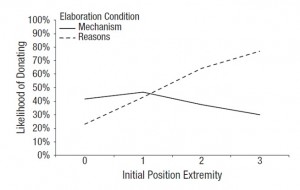
Participants first provided their position on the six policies. They were then assigned to one of four conditions and asked to elaborate on one of two policies: cap and trade or flat tax. Depending on condition, participants were asked either to generate a mechanistic explanation or to enumerate reasons for their position. Next, participants were told that they would receive a bonus payment (20 cents; equal to 20% of their compensation for completing the experiment) and that they had four options for what they could do with this bonus payment. They could (a) donate it to a group that advocated in favor of the issue in question, (b) donate it to a group that advocated against the issue, (c) keep the money for themselves (after answering a few additional questions), or (d) turn it down.

The researchers tried to reduce political extremity by asking participants to elaborate with causal links. In the reason generation condition, participants were asked to write down all the reasons they have for their position on a policy, going from the most important to the least. In the mechanistic explanation condition, participants were asked to describe all the details they know about a policy, going from the first step to the last, and providing the causal connection between the steps.

2. What They Found – Results:

              Among participants who initially held a strong position, attempting to generate a mechanistic explanation attenuated their positions, thereby making them less likely to donate. On the other hand, enumerating reasons did not have the same moderating effect as mechanistic explanation.

3. Who Was Studied- Sample:

U.S. residents from MTurk

4. Study Name:

Fernbach et al., 2013, Study 3

5. Citation:

Fernbach, P. M., Rogers, T., Fox, C. R., & Sloman, S. A. (2013). Political extremism is supported by an illusion of understanding. Psychological science, 0956797612464058.

6. Link:

http://www.meteo.mcgill.ca/~huardda/articles/fernbach13.pdf

7. Intervention categories:

generating mechanistic explanation

8. Sample size:

101

9. Central Reported Statistic:

              As predicted, there was a significant interaction between initial extremity of policy support and condition, Waldman’s χ2(1) = 6.05, p = .014. At the lowest level of initial support, there was no difference in likelihood of donating between the mechanism and reasons conditions, Waldman’s χ2(1) = 1.78, p > .18, but at the highest level of initial support, participants in the reasons condition were more likely to donate than were those in the mechanism condition, Waldman’s χ2(1) = 6.74, p < .01.

无标题

10. Effect Size:

Not reported

Study summary assignments:

Zhang Li


Read Ahead

Living Room Conversations Builds Trust Across Differences Concerning CA Prison Policy

At CivilPolitics, one of our service offerings is to help groups that are doing work connecting individuals who may disagree about political and moral issues.  These disagreements do not necessarily have to be about partisanship.  One organization that we work with is Living Room Conversations, a California based non-profit that holds small gatherings co-hosted by individuals who may disagree about a particular issue, in order to conciously foster non-judgmental sharing about potentially contentious issues.    Below is a description from their website, in addition to a short video.

Living Room Conversations are designed to revitalize the art of conversation among people with diverse views and remind us all of the power and beauty of civil discourse. Living Room Conversations enable people to come together through their social networks, as friends and friends of friends to engage in a self-guided conversation about any chosen issue. Typically conversations have self-identified co-hosts who hold differing views. They may be from different ethnic groups, socio-economic backgrounds or political parties. Each co-host invites two of their friends to join the conversation. Participants follow an easy to use format offering a structure and a set of questions for getting acquainted with each other and with each other’s viewpoints on the topic of the conversation.

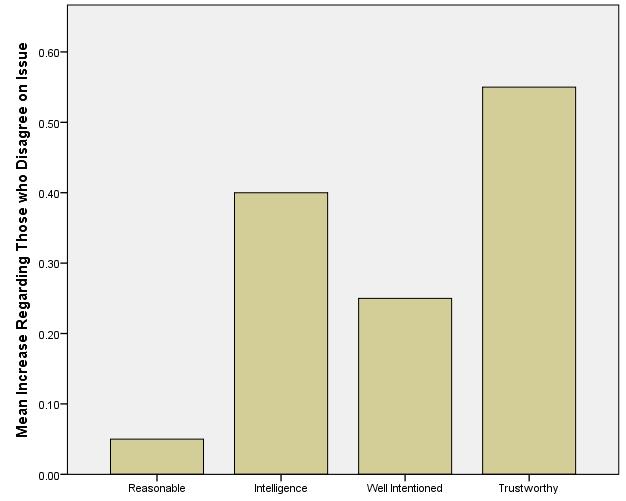
Living Room Conversations is currently holding conversations around the issue of “realignment” in California, which is designed to alleviate prison overcrowding and where many would like to develop alternatives to jail for non-violent criminals.  Living Room Conversations wanted help understanding the effects of their program so we worked with them to develop a survey appropriate for their audience, asking people about their attitudes before and after conversations.  Informed by work in psychology, we looked at how reasonable, intelligent, well-intentioned, and trustworthy people perceived those on the opposite side of the issue to be, compared to how they perceived them before the meeting.  Results, based on a 7-point scale, are plotted below.

LivingRoomConversationsTrust1

The fact that all scores are greater than zero means that people felt that individuals who disagreed with them on these issues were more reasonable, intelligent, well-intentioned, and trustworthy compared to how they felt before the conversation (though with a sample size of only 23 individuals so far, only the increase in trustworthiness is statistically significant).

There was still a stark difference between how people felt about those who disagreed on these issues compared to how they felt about people who they agreed with, as respondents both before and after the event felt that those they agreed with were more likely to be reasonable, intelligent, well-intentioned, and trustworthy.  As well, we asked people about their attitudes about realignment policy and people’s attitudes about the issue didn’t change.  However, civility, as we define it, is not the absence of disagreement, but rather being able to disagree in a civil way that respects the intentions of others.

Moreover, even if people’s minds hadn’t changed with respect to others, individuals felt strongly (8+ on a 10 point scale) that talking with others that hold different views is valuable.  Research on the effects of such positive contact would indicate that if these individuals do follow through on this course, they will likely end up building on these attitudinal gains toward those who disagree.  Given that, these conversations appear to be a step in the right direction.

– Ravi Iyer

Read Ahead
Our goal is to educate the public about social science research on improving inter-group relations across moral divides.