Educating the Public on Evidence-based methods for improving inter-group civility.

Pew Research highlights Social, Political and Moral Polarization among Partisans, but more people are still Moderates

A recent research study by Pew highlights societal trends that have a lot of people worried about the future of our country.  While many people have highlighted the political polarization that exists and others have pointed to the social and psychological trends underlying that polarization, Pew’s research report is unique for the scope of findings across political, social, and moral attitudes.  Some of the highlights of the report include:

  • Based on a scale of 10 political attitude questions, such as a binary choice between the statements “Government is almost always wasteful and inefficient” and  “Government often does a better job than people give it credit for”, the median Democrat and median Republicans’ attitudes are further apart than 2004 and 1994.
  • On the above ideological survey, fewer people, whether Democrat, Republican, or independent, are in the middle compared to 1994 and 2004.  Though it is still worth noting that a plurality, 39% are in the middle fifth of the survey.
  • More people on each side see the opposing group as a “threat to the nation’s well being”.
  • Those on the extreme left or on the extreme right are on the ideological survey are more likely to have close friends with and live in a community with people who agree with them.


The study is an important snapshot of current society and clearly illustrates that polarization is getting worse, with the social and moral consequences that moral psychology research would predict when attitudes become moralized.  That being said, I think it is important not to lose sight of the below graph from their study.
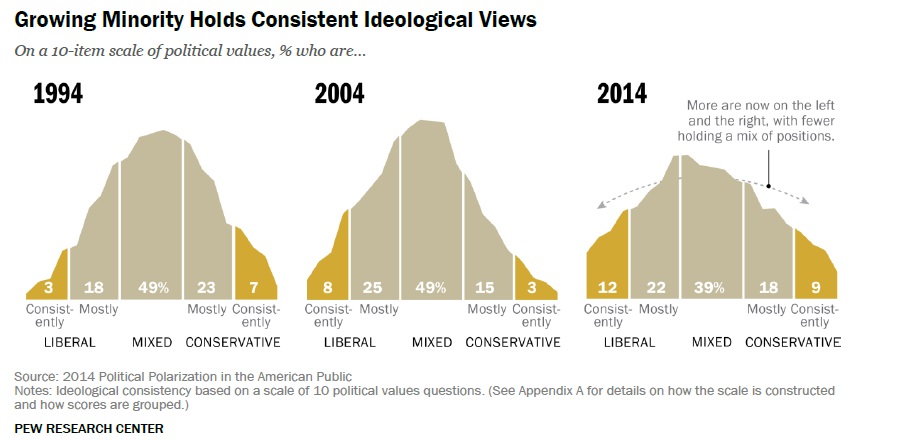
 

Pew Survey Shows a Shrinking Plurality holds Moderate Views


Specifically, while there certainly is a trend toward moralization and partisanship, the majority of people are in the middle of the above distributions of political attitudes and hold  mixed opinions about political attitudes.  It is important that those of us who study polarization don’t exacerbate perceived differences, as research has shown that perceptions of differences can become reality.  Most Americans (79%!) still fall somewhere between having consistently liberal and consistently conservative attitudes on political issues, according to Pew’s research.  And even amongst those on the ends of this spectrum, 37% of conservatives and 51% of liberals have close friends who disagree with them.  Compromise between parties is still the preference of most of the electorate.  If those of us who hold a mixed set of attitudes can indeed make our views more prominent, thereby reducing the salience of group boundaries, research would suggest that this would indeed mitigate this alarming trend toward social, moral, and political polarization.

– Ravi Iyer
Read Ahead

Intuitionism in Practice: How the Village Square puts Relationships First

Our friends at the Village Square recently wrote an article about how they have been able to bridge partisan divides in their community, based on their experiences at numerous community dinners they put on in their neighborhoods.  Their experience dovetails nicely with what has been found in academic psychology, specifically that any type of attitude change requires appealing to the intuitive side of individuals, in addition to the rational side.  Accordingly, their “irreverently named programs are part civic forum, part entertainment” where they seek first to build relationships to open people’s minds, before attempting to get people to rationally understand the other sides’ arguments.  From the article:

In “The Big Sort: Why the Clustering of Like-minded America is Tearing Us Apart,” Bill Bishop documents how, in nearly all aspects of life, we’ve become less connected to those who don’t share our views – in the churches we go to, the clubs we join, the neighborhoods we live in.

No longer engaging across the aisle with neighbors, there’s little to mitigate the human tendency toward tribalism. Once we’ve demonized each other, the simple act of talking is tantamount to negotiating with evil.

To address this challenge, our irreverently named programs are part civic forum, part entertainment. Each event is casual (the stage is set up to feel like the facilitator’s living room) and involves sharing food. As we begin, we give out two “civility bells,” ask that the audience avoid tribal “team clapping,” and share a quote to inspire our better angels. We welcome fluid audience participation and always try to laugh.

Since we first imagined The Village Square, we have repeatedly returned to the same conclusion: We can’t wait around for Washington to lead on this. It’s in our hometowns, where we carpool to softball games and borrow cups of sugar, where we can most easily have the conversations democracy requires of us.

Recently, there has been a lot of re-examination of social science findings that may or may not replicate, especially in real-world environments.  The fact that social science research that emphasizes the importance of personal relationships in changing attitudes has found real world application and validation is comforting for those of us who would like to leverage this research in reducing morally laden conflicts.  Those of us who would like to mitigate the natural animosity that arises when competing groups are formed would do well to follow the Village Square’s lead and put relationships first.

– Ravi Iyer

Read Ahead

Reducing Self-Interest Bias in Conflicts by Mitigating Disparities in Liking

One of the most difficult things for all of us to overcome in any competitive situation is self-serving bias.  The below video explains it in an intuitive and entertaining way.  How many sports fans can be counted on to objectively view the decisions of referees?  Not many.  And similarly, how can we expect members of a group to objectively judge the fairness of actions of other group members?  Even those of us who take great pains to see the viewpoints of the other side are likely influenced by unconscious bias in service of our self-interest.

These same processes explain how both Jews and Palestinians have divergent historical narratives that they are completely convinced is the only view, how fiscal liberals and conservatives have completely opposite ideas about economic history, and how sports fans can be so convinced that they are routinely robbed by referees.  Opposing groups are often going to see facts in a way that conforms to their moral worldview (see research on and examples of moral coherence).

Self-serving bias may be ubiquitous, but there are still situations and circumstances that may reduce or exacerbate these tendencies.  Recently, at the 2014 conference for the Society for Personality and Social Psychology, I met Konrad Bocian who is investigating liking as a potential boundary condition.  Specifically (as is described in the below video), self-serving bias may occur only when it is done by people one has greater liking for.  In three studies, Bocian and Wojciszke measured moral judgments of rule-breaking behavior that benefited the judging party, and observed that feelings toward the perpetrator of the behavior were central to these moral judgments, even when the behaviors benefited the judging party.

This work relates to the Asteroids Club paradigm that is being pioneered by The Village Square, in that a central aspect of such meetings is to reduce the disparity in liking between members of one’s own group and members of opposing groups.  This hypothesis should be tested directly, but perhaps in moderating our feelings toward both our own groups and competing groups, we can mitigate some of the self-interest bias that exists in all conflicts and learn to disagree more productively.

– Ravi Iyer

ps.  Read more at Konrad’s website or read the published paper here.

Read Ahead

More Information does not necessarily lead to Civility

A recent article by Ezra Klein at Vox.com eloquently makes an argument that we at CivilPolitics have also done a lot of research in support of – specifically, that if you want to affect many behaviors, you cannot just appeal to individuals’ sense of reason.  The article is well worth a complete read and is excerpted below, but the gist of it details a simple clear study by Dan Kahan and colleagues, showing that individuals who are good at math stop using their rational skills when the use of those skills would threaten their values.

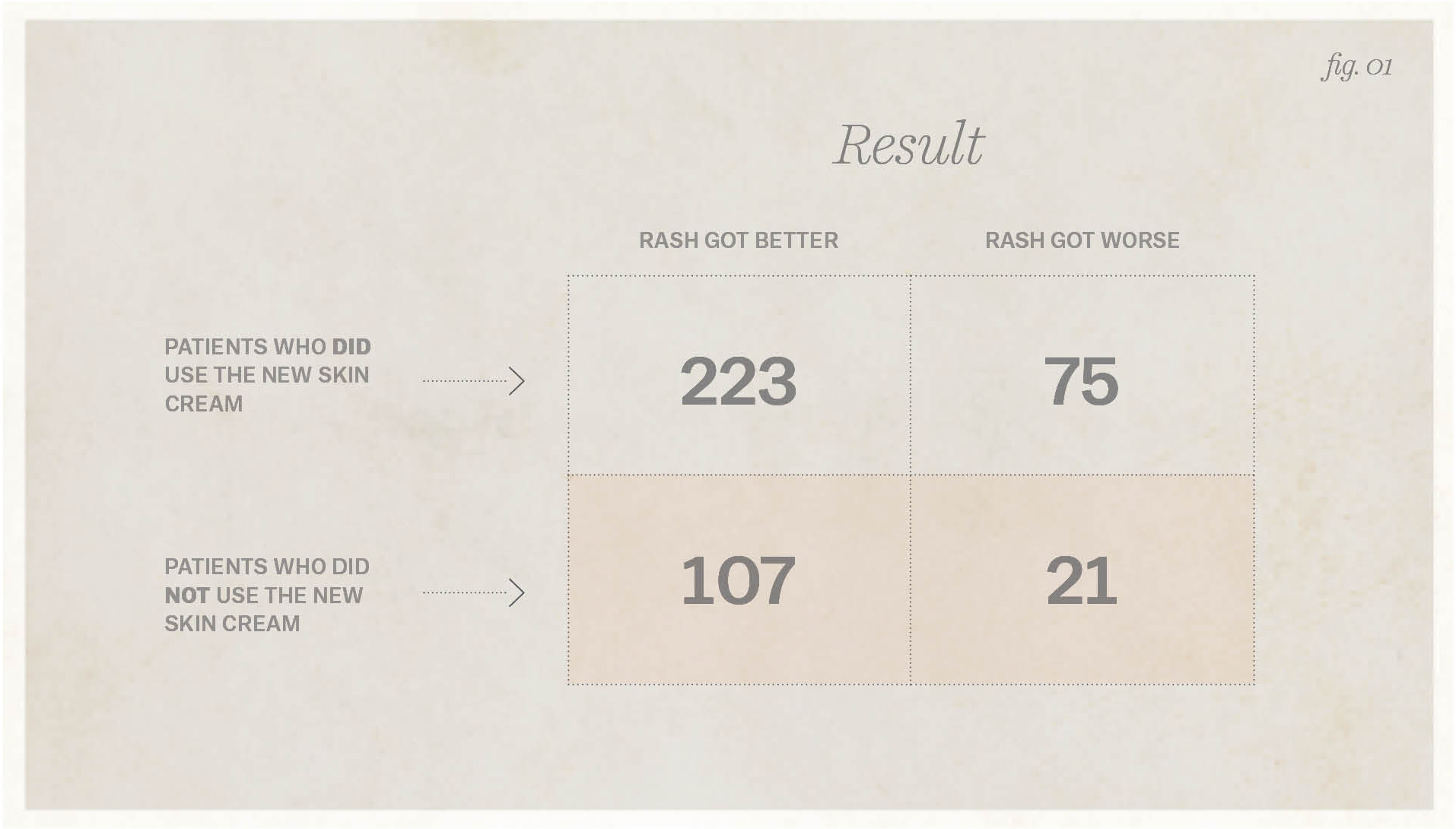
How was this shown?  Consider the below table of results of a hypothetical study on whether a skin cream helps individuals with a rash.  Did the skin cream work well?  Simply scanning the numbers may give you the impression that the skin cream did well, as 225 is the highest number in the chart, yet if you look closer at the numbers, you’d find that the use of the skin cream is actually more likely to do harm than good, when compared to not doing anything at all.  However this kind of logical reasoning takes effort.

math-problem


Kahan’s work shows that we aren’t willing to make this kind of effort when the results would conflict with our values.  Specifically, when confronted with a ideologically charged political question (e.g. gun control) framed in the same terms, individual skill at math no longer predicts being good at solving such a problem .  Instead, one’s ideology was the main predictor and this was true for both liberals and conservatives.  From the article:

Presented with this problem a funny thing happened: how good subjects were at math stopped predicting how well they did on the test. Now it was ideology that drove the answers. Liberals were extremely good at solving the problem when doing so proved that gun-control legislation reduced crime. But when presented with the version of the problem that suggested gun control had failed, their math skills stopped mattering. They tended to get the problem wrong no matter how good they were at math. Conservatives exhibited the same pattern — just in reverse.

Being better at math didn’t just fail to help partisans converge on the right answer. It actually drove them further apart. Partisans with weak math skills were 25 percentage points likelier to get the answer right when it fit their ideology. Partisans with strong math skills were 45 percentage points likelier to get the answer right when it fit their ideology. The smarter the person is, the dumber politics can make them.

Consider how utterly insane that is: being better at math made partisans less likely to solve the problem correctly when solving the problem correctly meant betraying their political instincts. People weren’t reasoning to get the right answer; they were reasoning to get the answer that they wanted to be right.

If more information is not the solution to producing civility, than what is?  Our expertise at Civil Politics.org is in social psychology, which often concerns the subtle influences that can affect our non-rational side.  While we are still working on a comprehensive set of recommendations (check our blog for continuing progress and research), our social psychology page details a few simple principles that one can use in addition to providing information.  Specifically, getting people to like each other more can make them more open to opposing arguments.  Providing a non-oppositional framework also creates space that allows for more civil thoughts.  These themes also run through the work of organizations we work with, such as Living Room Conversations and The Village Square, which, consciously or not, effectively use social psychological principles in their work.  Whether you are more convinced by research in the lab, case studies, or a combination, the evidence is clear – more information, by itself, will not bring groups closer together.  To do so requires considering the many emotional and psychological motivations that we all have.

– Ravi Iyer

Read Ahead
Our goal is to educate the public about social science research on improving inter-group relations across moral divides.