Educating the Public on Evidence-based methods for improving inter-group civility.

The First New York City Asteroids Club Dinner

The Asteroids Club is any group of people  with diverging political views who gather not to debate, but to listen to the other side explain why it is concerned about certain threats. The metaphor is meant to capture the fact that there are many threats coming at the United States–like asteroids scheduled for direct hits—yet each side of the political spectrum focuses on a few of them and ignores or discounts the asteroids that most worry the other side. As John Stuart Mill said in 1840: “in almost every one of the leading controversies… both sides were in the right in what they affirmed, though in the wrong in what they denied.” The Asteroids Club is a novel format for bringing people together, over a meal, for a discussion in which each side helps the other to see more clearly. The format has been developed by The Village Square, in Tallahassee Florida.

The Nathan Cummings Foundation hosted the first New York City Asteroids Club dinner on February 26, 2014, in the home of its president, Simon Greer. The foundation is in the process of updating its research and funding portfolios, and its leaders were interested in learning more about the issues of income inequality and the causes of poverty. They were also interested in developing relationships with experts from diverse perspectives who could help them understand these complex topics. Simon and I therefore chose the two asteroids of rising income inequality (a topic of greater concern on the left), and declining rates of marriage and family stability (a topic of greater concern on the right).

This report is intended to be useful for anyone interested in hosting future dinners, or in bridging the political divide more generally. However, we note that we decided to invite experts from right and left to the first dinner, rather than ordinary people, to maximize the degree to which we could learn about the best thinking and research on these topics. This dinner may therefore not be representative of what will happen if the Asteroids Club format is rolled out and used widely by civic groups across the nation.

Preparing For the Dinner

We ran the dinner using the Chatham House rule, which says that participants are free to write about the event, but cannot reveal the identities or affiliations of the speakers. So we will simply say that we invited two very prominent and well-respected journalists, one clearly identified with liberalism, one with conservatism. We asked these two co-hosts to suggest additional people they wanted on their “team.” (We had hoped to avoid the terms “team” or “side,” but it was hard to do so.) These two co-hosts then nominated several other experts, and took a few suggestions from Simon and me about experts we know on both sides. All 10 people who were invited accepted the invitation. The final dinner was attended by 18 people: 6 liberals, 6 conservatives, Simon and me (who served as co-hosts), and four observers affiliated with the foundation. The expertise in the room was extraordinary, including journalists, economists, activists, and people with experience in government and policy-making.

Two weeks before the dinner, we assembled a list of readings nominated by the participants and posted them all in a google document that we used to share information and coordinate the evening. Because these prominent participants were all extremely busy, we did not push for them to do much preparation beforehand, although we did encourage them to read one or two articles from the other side, and to watch my TED talk that introduced the idea of the asteroids club.

The Dinner

The evening began at 7:30 with drinks, hors d’oeuvres, and unstructured socializing, which was quite cross-partisan. At 8:00 the two teams convened separately to go over final plans for their presentation. (In retrospect we should have encouraged the two teams to do more of this online, before arriving at the dinner). Around 8:30 everyone moved into the dining room and sat in seats that had been assigned to ensure a good mix of people at each of the two long tables. Simon welcomed everyone to his home and presented the Hebrew conception of two kinds of argument: machloket l’shem shamayim – argument that is for the sake of heaven which is intended to better discern truth and move the world forward,  and 2) machloket she’lo l’shem shamayim – an argument that is not for the sake of heaven, but is just for the sake of itself or for the sake of being controversial. Argument in pursuit of truth is considered sacred in the Jewish tradition.

I then explained the history of the Asteroids Club format, and went over the groundrules, including the Chatham house rule, the exact schedule, and the role that I would play as timekeeper and moderator. Each of the participants then offered a 1-minute introduction of him- or herself. We then served ourselves dinner from the buffet, and began the structured discussion. The schedule that we intended to follow was this:

9:00 begin Asteroid #1: rising inequality, liberal side presents
–15 minutes to describe the threat; why this matters, why it’s urgent….During this time, the listening side gets to ask a few brief elaborative questions, but hold argumentative questions for the next step.
–5 minutes for “telescope” time — conservatives ask critical questions, request more info, challenge assumptions.

9:20 begin Asteroid #2 family breakdown, conservative side presents
–15  minutes to describe the threat; why this matters, why it’s urgent…. During this time, the listening side gets to ask a few brief elaborative questions, but hold argumentative questions for the next step.
–5 minutes for “telescope” time — liberals ask critical questions, request more info, challenge assumptions.

9:40: dessert served, short break
9:45 Integrative discussion, 20 min.
–10 min: Return to Asteroid #1: Inequality. Go deeper: what does the liberal side most want to change, address, or at least have understood (taking into account family breakdown)
–10 min: Return to Asteroid #2: Family Breakdown: Go deeper: what does the conservative side most want to change, address, or at least have understood? (taking into account rising inequality)

10:05 Concluding discussion and resolutions.
10:30: End of formal discussion, take closing survey.

The schedule we actually followed was close to this, but because we were running behind and because there was clearly a surprising amount of agreement on what aspects of poverty were of great concern, I decided to merge the two parts of the integrative discussion into a single discussion of what really matters – what issues either side had raised that seemed to elicit at least some assent from the other side.

In general there was bipartisan agreement that income inequality has been rising in recent decades, although there was NOT bipartisan agreement that rising inequality itself was a problem that needed to be addressed. There was, however, bipartisan (though not necessarily unanimous) agreement that the following issues are concerns or problems, and that we would be a better country if we could address them:

  • Dignity, and the indignities disproportionately suffered by the poor

  • Distrust of government and democracy

  • Waste: the financial squeeze and inefficiency caused by “arms races” as people spend more money to attain “positional goods” such as a home in a good school district.

  • Lack of opportunity for large segments of society; The waste of human potential among the poor.

  • Declining motivation and economic dynamism – which can be stimulated by moderate degrees of inequality (this point was noted by a liberal)

  • Abuses of power, which becomes easier for those with a lot of money

  • Separateness – having communities that are cut off from the mainstream of society; having low social trust and cohesion.

In general there WAS bipartisan agreement that marriage rates and family stability have declined in recent decades. There WAS bipartisan agreement that these trends are bad for society, and that it would be good if we could find ways of reversing the trends. There was a very high degree of bipartisan concern about poverty, especially for its pernicious effects on children. There was also a consensus that the people who suffer most from these trends are single mothers (who bear the main costs and stresses of raising children under often adverse circumstances) and their sons. Daughters suffer too, of course, but there was consensus that boys’ outcomes are more adversely affected by the absence of a father, and these adverse outcomes then set up a feedback loop for the next generation in which there are way too few stable, employed, and marriageable young men who could break the cycle of father-absence.

The Post-Dinner Assessment

We are working with my colleagues at CivilPolitics.org to develop assessment tools that can be used by any organization running any kind of civility-enhancing event. For future events, we will send all participants a link to a web-based survey  a few days before the event, then pass out a paper questionnaire at the conclusion of the event, then send out a web-based followup survey a week after the event, to assess the effects of the event on attitudes about the asteroids, and about the people on the other side. For this first dinner, with 12 super-busy people, we only obtained four responses to the first web survey. (You can see that first survey here. Future versions will be much more extensive.) We therefore decided to focus our efforts on obtaining measures of the key variables at the conclusion of the evening. Did people come to see the asteroid presented by the other side as a clearer or more pressing threat than they had before the dinner? That is the central goal of an Asteroids Club dinner.

We collected responses from all 6 liberals and from 5 of the conservatives.  For each asteroid, we asked participants whether their views had changed regarding both the PACE of the threat and the SEVERITY of the threat.  For example, here is the exact text of one of the four main questions:

How has tonight’s discussion influenced your beliefs about the severity of the problem of income inequality for the USA?
___I now see it as a much less severe problem than I did a week ago
___I now see it as a slightly less severe problem than I did a week ago
___The discussion did not influence my beliefs in either direction
___I now see it as a slightly more severe problem than I did a week ago
___I now see it as a much more severe problem than I did a week ago

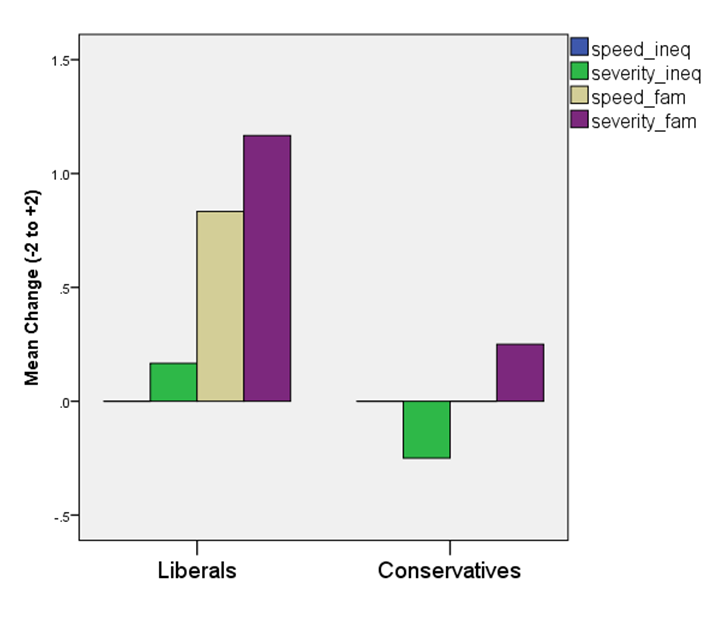
The graph below shows the results. Let’s start with family decline. The liberals (shown on the left half) DID move in the desired direction. They now see it as a more rapidly approaching threat (gold bar, 4 moved), and a more severe threat (purple bar, 5 moved). The conservatives did not really move on family decline, nor did we expect them to. (The gold bar doesn’t even show  because nobody moved.)

On inequality, the story was quite different. No conservative moved at all on the speed of the change (which is why the blue bar does not show), and the only movement on severity came from a single conservative who said that he/she now sees the problem as “slightly less severe” than before. (The liberals also showed no movement on inequality, except for a single participant who said “slightly more severe” than before.)

What can we make of this pattern?  It appears that the asteroids club format worked for the family decline asteroid. The conservatives presented the asteroid, the liberals listened, and then came to see it as a greater threat. This is very encouraging.

But it is harder to know how to interpret the results on the inequality asteroid. The lack of movement could have resulted because A) the liberal team made a weaker case about inequality than the conservatives had for family decline, or B) the conservatives were less open-minded and willing to listen, or C) the facts about inequality and its harms are truly more ambiguous and contestable than they are for the family decline asteroid. My conclusion from the background reading, and from the conversation during the dinner, is that C is true and is at least part of the explanation.

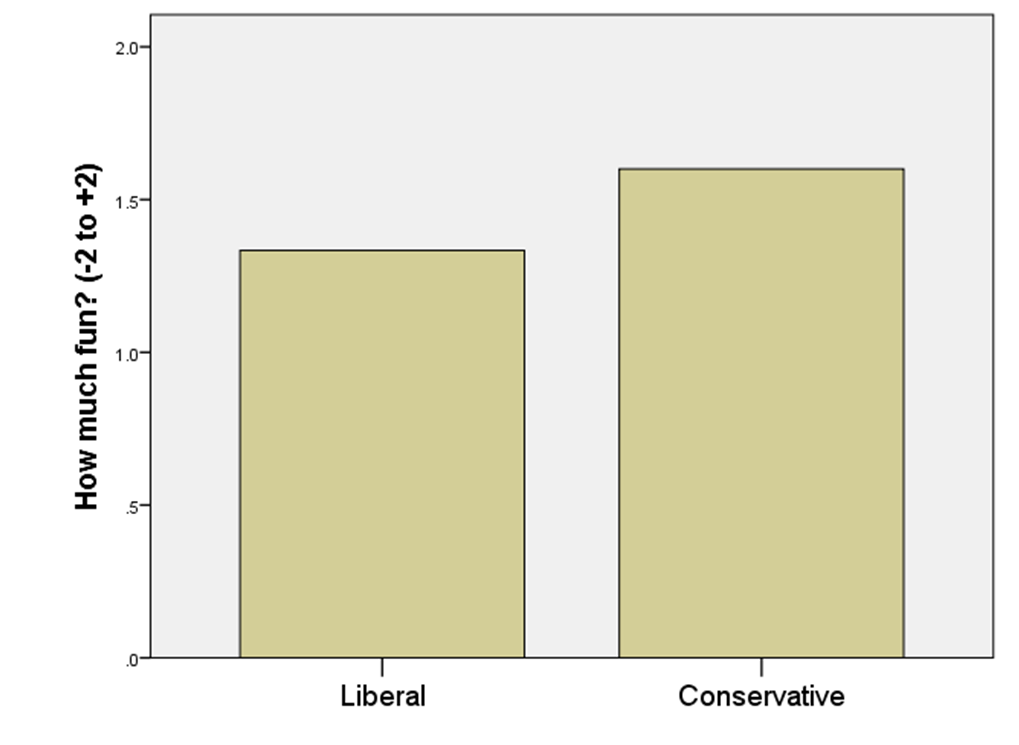
We also asked: “Compared to other discussions about policy and politics you’ve had in politically ‘mixed company,’ how enjoyable was this ‘asteroids club’ format?”  We offered 5 choices, ranging from “much less enjoyable” (scored as -2) to “much more enjoyable” (scored at +2). Six respondents said “much more enjoyable,” one said “about the same,” and four said “slightly more enjoyable.” There was no significant difference between the liberals and conservatives, which is quite encouraging


Conclusions and advice for future Asteroids Club dinners:

Based on the data above, and on comments made by participants after the dinner, I draw the following conclusions and lessons:

1) The format is enjoyable and promotes civil interaction. Sharing a meal in a private home seems to have made people particularly polite and open.

2) It is difficult to do two asteroids in a single 2 hour discussion. There are advantages to doing two – it led to a sense of balance and fairness. But at least 3 hours of discussion would have been needed to cover both.

3) Relationships matter, and it takes time to get to know each other and develop trust. Ideally, asteroids clubs will be true clubs, with a stable membership that meets every month or two.

4) The exact instructions for each part of the evening matter. More work is needed, drawing from experts in negotiation and facilitated discussion, on how to optimize the integrative discussion and conclusion.

5) More “warmup” exercises could be tried. We kept this evening fairly direct and cerebral – focused on the ideas and research. But future events could begin with more activities to build trust and cohesion, such as singing the National Anthem, or doing introductions in a much more personal way, or pairing off in bipartisan teams for short initial discussions, and then having participants report to the group by introducing their partner and his/her main concerns.

The bottom line is that we created a novel social situation which called for openness, trust, and collaborative thinking, and the participants rose to the occasion. There was no partisan sniping and not a shred of hostility. People sometimes made points that supported the other side. Many on both sides expressed a desire to continue the conversation. Which we will do, in a way soon to be announced.

If you are interested in hosting an Asteroids Club dinner yourself, please visit: www.AsteroidsClub.org

Jon Haidt

Read Ahead

Join the Transpartisan Listserv!

We in behalf of NCDD are pleased to invite everyone to join the new Transpartisan Listserv. The vocation for this moderated email discussion list is to provide a simple, safe communication channel where individuals and organizations can connect and learn from each other.

The purpose of this listserv is to introduce potential colleagues to one another, expand our knowledge of transpartisan theory and practice, and showcase ongoing activity in the transpartisan field.

Please consider being part of the Transpartisan List if any of the following are true:

  • You are interested in learning more, and sharing what you know, about current efforts to transcend and transform unproductive partisan politics.
  • You want to meet potential colleagues who share your concern and are working to improve research, dialogue, deliberation, collaboration, and improved decision making across party lines.
  • You want to share what you (or your organization) do in this field that you consider “transpartisan” – conversations that break out of the narrow, predictable ideological exchanges.
  • You believe this subject is vital to our country’s future and simply want to learn more about how you might get involved.

You can subscribe to the Transpartisan List by sending a blank email to transpartisan-subscribe-request@lists.thataway.org. Together, we can ask the questions that need to be asked about this challenging field, and seek the answers as a learning community.

Click the link know more about the NCDD & the Transpartisan list: http://ncdd.org/14227

Read Ahead

Healing the Divide by Ruining Lives

[This is a guest post by Robert Fersh, the president of The Convergence Center for Policy Resolution.]

One could be forgiven for thinking that the acrimony and dysfunction that’s come to characterize our national politics is immutable. After all, longtime Congressional observers and the national media have deemed our current crop of elected officials the “most dysfunctional” and “least productive in history”—not exactly awards a well-meaning public servant angles for. The signs of breakdown are everywhere; public approval of Congress recently sunk as low as 9% – the lowest rating since polling began in 1976.

Yet as someone who works with equally passionate, ideologically opposed groups to find points of common ground on national issues, I can tell you it does not need to be this way.

It’s true that we have a wide spectrum of opinions and temperaments in our debates, but differing views don’t have to roil the nation and paralyze us from acting.  The creative tension among strong, opposing views can fuel better solutions than any one party or political perspective can provide.

The secret is to engage with others, with a focus on listening and respect, rather than on questioning motives or winning debates.  This is not a blind plea for politeness; this is hard work. It requires discipline and patience, and welcomes respectful argument.  If practiced well, this approach won’t just yield civility, but also not-otherwise-possible solutions that energize and inspire all participants. We not only need politicians and political leaders to do this, but also myriad organizations, businesses, civil society groups, and citizens as well.

Several years ago, I directed a project involving top, and often conflicting, national organizations attempting to find common ground on health care coverage for the uninsured. The participants’ ideological differences were, from a distance, not unlike those that led to the 2013 government shutdown.  Yet this group of “strange bedfellows” managed to agree on substantive recommendations and a plan to work together to provide health coverage to most of the then-estimated 47 million Americans who lacked it. Some of their key recommendations have since been enacted into law.

The process not only achieved dramatic policy results, but also deeply affected the individuals involved. One participant from a physicians group told me: “When we started, I thought I knew exactly how to cover the uninsured. My group had thought this through. We had the right answer.  And now, after spending time with all these smart, caring people from other places, I cannot see the world or this issue the same way.  You have ruined my life!”

As another think tank participant put it, “I had known most of these people for many years. Yet in this process, an entirely different dynamic and better result occurred because we took the time to really understand each other and address the concerns each of us had, rather than just blindly advocate for what we believed when we started.”

There’s a simple lesson at play: None of us wants our own views discounted or demonized, but we routinely do that to the “other side.”  For us, the golden rule seems to apply only to those we perceive to share our values and viewpoints.

We’re no Pollyannas. We understand that this process may not work for all topics at all times.  But there is a track record of success in various policy arenas and there are experienced, skilled practitioners who are ready to serve the nation.  And there are glimmers of hope in Congress, including bipartisan cooperation on immigration reform and a newly reached budget deal.

Social psychologist Jonathan Haidt, author of The Righteous Mind: Why Good People Are Divided by Politics and Religion, said in an interview in 2012: “Wisdom comes out of a group of people well-constituted who have some faith or trust in each other.  That’s what our political institutions used to do, but they don’t do anymore.”

Polarization and gridlock don’t have to be permanent political watchwords if we can find leaders from all sectors with the courage to embrace a new approach.  If we actively engage those who disagree with us, we may “ruin” some lives, but we will be all the better for it.

 —————————————

Robert J. Fersh is the president of Convergence Center for Policy Resolution, a national organization that convenes people and groups with conflicting views to build trust, identify solutions, and form alliances for action on critical national issues. He has held leadership positions working for Congress, in the Executive Branch, and in the non-profit sector in Washington, DC for over 35 years.

Read Ahead

Event: The 2014 Harvard Negotiation Law Review Symposium: Political Dialogue and Civility in an Age of Polarization

Harvard and The Program on Negotiation is sponsoring an event: The 2014 Harvard Negotiation Law Review Symposium: Political Dialogue and Civility in an Age of Polarization. It will be held at Austin Hall, Harvard Law School Campus on Saturday, March 1, 2014, 9:00 am – 4:30pm. The event will be free and open to public, click the link to register for the event.

Polarization and the damage it causes are evident in political and civic life and  impede a more thoughtful and productive dialogue. Policy makers, lawyers, and scholars will be discussing the ways in which negotiation, mediation, and other dispute resolution skills can improve the quality of our civic engagement and, ultimately, our political system.

The conference’s focus will be on applying ADR principles to overcome the polarization rampant in today’s politics. Panelists will both discuss the theoretical and practical frameworks, with a focus on dispute resolution strategies that have successfully resolved domestic and international policy issues in the past.

Host and producer of the award winning public radio program “On Being”,  Krista Tippett will be the keynote speaker for the event.

Panelists of the event:

  • Peter Ambler, Founder, Strategy Director at Americans for Responsible Solutions and Special Adviser at the U.S. Department of Energy
  • Tom Bonier, Co-Founder and Partner at Clarity Campaign Labs
  • Robert Bordone, Founding Director of the Harvard Negotiation and Mediation Clinical Program, and a member of the Executive Committee of the Program on Negotiation
  • Jim Flug, whose long political career included and appointment as Chief Counsel to Senator Ted Kennedy
  • Carolyn Lukensmeyer, founder of AmericaSpeaks and Consultant to the White House Chief of Staff during the Clinton administration
  • Michael Ostrolenk, National Director of the Liberty Coalition

Detailed schedule for the symposium. For more information, please visit HNLR’s website.

Read Ahead
Our goal is to educate the public about social science research on improving inter-group relations across moral divides.