
Educating the Public on Evidence-based methods for improving inter-group civility.

Those who want a fight, like Trump and ISIS, do indeed benefit from each other.

During the recent Democratic debate, Hillary Clinton stated that Donald Trump has become a lead recruiter for ISIS.  I can’t speak to the accuracy of this claim, and much has been written from both sides elsewhere.   However, there should be very little doubt that those who benefit from conflict need the level of perceived competition to be ever greater, in order to justify their combative stance within their own group, implying that the extremes on both sides of any conflict do indeed have common goals.  That is true in social science laboratory experiments, natural experiments that occur in the world, analyses of history, in our everyday experiences and yes, it is true with regard to those who benefit from a perceived “clash of civilizations”, such as Donald Trump and ISIS.  Indeed, it would be shocking if it didn’t work that way for Trump and ISIS, as shocking as it would be if gravity worked in some places and not others, as these forces are fundamental parts of human nature.  We are naturally social animals who are exceedingly good at forming groups and competing with opposing groups.  The more competitive the situation gets, the more animosity arises and the more we gravitate toward the most combative amongst our group.

Need proof?  Here are five forms of evidence that suggest this is true.Scarborough,_North_Yorkshire_-_WWI_poster
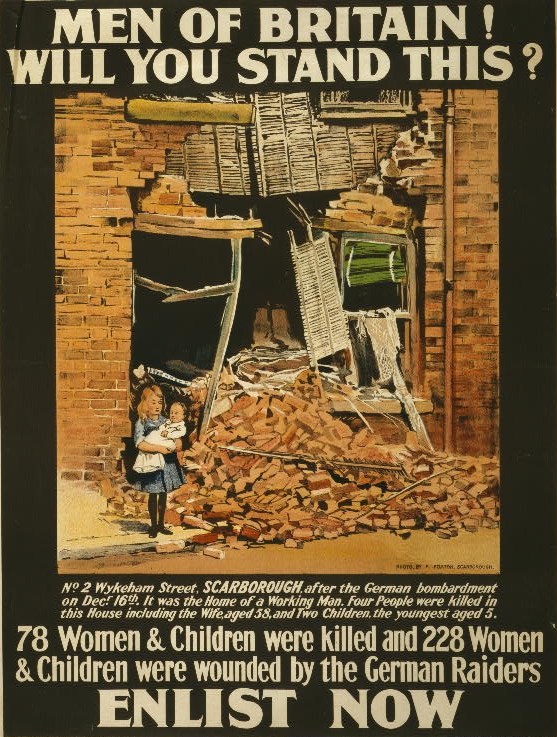
1) Social Science – Thousands of studies have used the minimal group paradigm, whereby the mere fact of assigning a person to a group creates animosity and the more competitive the groups are, the more animosity ensues.  The reason the procedure is called “minimal” is that there is no actual reason why any person is put in any group, such that any reason for conflict is simply a result of random group assignment + competition, not any real difference between individuals.  During these manufactured competitions, group members are more likely to follow others who suggest attacking the other group.

2) The Natural Experiment of Sports – How do we know that the minimal group paradigm maps onto real world behavior?  Millions of people engage in animosity toward very similar others due to the arbitrary assignment of where they happen to live and what sports team they then follow.  Thousands of papers have been written to analyze this behavior (I’d recommend Among the Thugs most), but you don’t need academic analyses to know that rivalries lead to violence across sports and countries, as it happens regularly in the news.  Importantly, the only thing that often differentiates these groups is the level of competition between them;  the greater the competition, the more animosity, and the more opportunity for heroes to arise, who lead their side to victory.

3) History – How do dictators get their populace to follow them, despite their often ineffective leadership?  North Korea needs a perpetual sense of threat to justify the terrible conditions it imposes on it’s people.  Hitler, Stalin, Pol-Pot, and Putin, in modern times, maintain(ed) their hold on power not by providing a better life for their people, but by “protecting” them from a very dangerous world.  The more competition that exists with other countries, the better their hold on power, a phenomenon that has noted by political scientists in the US as well.

4) Everyday experience – A lot of social science and history simply confirms what we already know from our everyday experience.  When was the last time that you got into an argument with someone and one party willingly conceded their point of view?  The more heated the debate, the less you listen to others, and the fact that social scientists have found this to be true is almost beside the point.  Creating a more extreme atmosphere is a great way to shut down reasoned debate and compromise.

5) Trump & ISIS – I don’t doubt Trump’s sincere desire to defeat ISIS, but support for his candidacy has clearly increased as more terrible events occur in the world.  Indeed, a prime emphasis of his candidacy is competition with ISIS, China, Mexico, etc, and his proposed toughness in dealing with them.  He demonstrates this toughness by being ever more extreme.  Similarly, while systematic analyses of terrorist attitudes are sparse, groups like ISIS have often arisen in response to perceived invasions of Islamic territory such as in the Middle East or Afghanistan,  and a prime emphasis of ISIS’ propaganda is over-the-top shock videos designed to display toughness, in the face of these threats.

In the end, human beings will rally to a “tough leader” when under threat.  Intentional or not, those who demonstrate their toughness through their extreme rhetoric, often benefit from this threat, leading those on either extreme side of any moral division to be strangely aligned in terms of their incentives.  Trump & ISIS’ relationship is similar to the relationship between Democrats and Republicans who fundraise off of the extreme words of the opposing side or the Ohio State and Michigan athletic departments, who each earn millions from their rivalry or Hamas and the current conservative Israeli government, who both gain in popularity based on each others’ more extreme actions, or east coast and west coast rappers, whose rivalry led to millions in album sales.  Human beings love competition and often, those who promote the competition amongst us reap the rewards.  Unfortunately, some of these competitions have enduring consequences and there are times when those of us who would prefer to build bridges rather than walls need to get psychology working for us, rather than against us.

– Ravi Iyer

Read Ahead

Diversity in political opinion leads to better policy

Both in my academic and industry work, I work a lot on crowdsourcing answers, as multiple sources of information are inevitably going to lead to better conclusions.   The key to good crowdsourcing is not the volume of people, but the diversity of people in any dataset (e.g. this paper).  David Blankenhorn, of the Better Angels initiative, applies this same logic to improving policy through diversity of political thought.

From the article:

“Diversity,” like so much else these days, divides us….diversity, properly understood, might be our last best hope of repairing our broken politics and depolarizing our society. Consider three factual propositions.

Diverse groups make better decisions. If you’re an investor seeking an accurate prediction of next year’s inflation rate, should you go with your own best analysis, depend on a famous expert whose judgment you trust, or put your faith in the mathematical average of 50 predictions made by experts holding widely divergent views on inflation? Research suggests that the third strategy is consistently more likely to produce the most accurate prediction. Diverse groups are smart.

Like-minded groups make us individually dumber. I like to imagine that my political opinions come from evaluating evidence and sorting through facts, but I’ve learned from the research that it just ain’t so. Like you and nearly everyone, my political stances are largely shaped by ordinary human needs to belong, to maintain cherished relationships, and to protect or try to enhance my status within the groups that matter to me.

….

Groups shaping our political views have become less diverse. Both of our main political parties increasingly consist of like-minded people. It’s hard today to find a liberal Republican or a conservative Democrat. Our residential communities are also increasingly politically like-minded. In 1976, about one in four Americans lived in a county in which presidential candidate won by a landslide. Today that number is one in two. Increasingly, the news sources we use today tell us only what we already think. Finally, friendship circles today are increasingly politically defined, with liberals befriending other liberals and conservatives rarely inviting a liberal to lunch. (Where would they go — Cracker Barrel or Au Bon Pain?) So many of us today are nearly fully enveloped in political similarity. The main results are dumbed-down thinking and increasing polarization.

Creating a more civil political environment is not just beneficial for our relationships in our communities…it also leads to better, smarter policy.

– Ravi Iyer


Read Ahead

Israeli Restaurant Hummus Bar shows a path forward to peace

Sometimes it seems like it is only the extremists seeking to pull people further apart that make news, so it was heartening to see this story of an Isreali restaurant that gives people a 50% discount if they are seated at a table with both Arabs and Jews sitting together.  In keeping with this site’s perspective that situational, intuitive approaches to bringing people together that put relationships and cooperation first, tend to work better than overly rational approaches, we applaud their efforts as we have seen how similar programs by The Village Square and Living Room Conversations can shift the wind in a community.  Even as people maintain their political views, they can do so without demonizing people with the opposing view.  And enjoy a nice meal at a fair price too, in this case.


From the Times of Israel:

Hummus Bar took an innovative approach to getting Israelis and Arabs together in the midst of over two weeks of near daily terrorist attacks.

“Scared of Arabs? Scared of Jews?” the joint advertised in a Hebrew-languageFacebook post. “By us we don’t have Arabs! But we also don’t have Jews… By us we’ve got human beings!

Manager Kobi Tzafrir said that by the post-lunch rush on Monday, Hummus Bar had already served several tables with both Arabs and Jews, a trend that’s been consistent since the ad went up on Facebook on October 13. He said the idea’s been well received by Arabs and Jews alike, as well as people online from as far afield as Japan who’d heard of the initiative.

Tzafrir said the move was a response to growing intolerance by both Arab and Israeli extremists and was a small step to bring people together.

Please do support this restaurant and people who make similar efforts in your communities.

– Ravi Iyer


Read Ahead

Psychological Patterns evident in Reactions to the Iran Nuclear Deal

Whether the deal that has been reached will or will not stop Iran from getting nuclear bomb is a question better left for experts in atomic energy and weapons, but there are some psychological processes occurring in reactions to the deal that are quite common and bear pointing out.

– The people who are most concerned about their side getting a bad deal in both Iran and the US are the ones who both are simultaneously are convinced that their side got the worst of it.  Just as those on the extremes of the Democratic and Republican party are most quick to criticize any compromise, so too are those who are most partisan in the Iran-US divide most likely to disagree with the compromise, even as they disagree in opposite directions, each saying that the deal is tilted toward the benefit of the other side.  This converges with work in psychology on how extreme beliefs often lead people to be more critical of mixed evidence.  The Iran deal is a long and complex document and each side can find what it needs to in order to prove it’s case.

– It is psychologically more healthy to believe that one has control than to believe that one does not.  So naturally Obama believes that this deal will control Iran’s nuclear ambitions, even as no verification scheme is perfect.  And critics of the deal insist they could indeed get a better deal, even as those efforts would be dependent on other countries like Russia and China to keep or increase sanctions.  Clearly, there is a lot more uncertainty as to whether this deal will work or whether a better deal was possible.

In the end, the bias of our organization will almost always be toward compromise over conflict.  That being said, given what we know about human psychology, we’ll be looking for the analyses of non-partisan experts who talk in probabilistic terms over the certain language of the most partisan analysts to truly evaluate this deal.

– Ravi Iyer


Read Ahead
Our goal is to educate the public about social science research on improving inter-group relations across moral divides.