
Educating the Public on Evidence-based methods for improving inter-group civility.

“In-Group Love” without “Out-Group Hate”

“In-Group Love” without “Out-Group Hate”

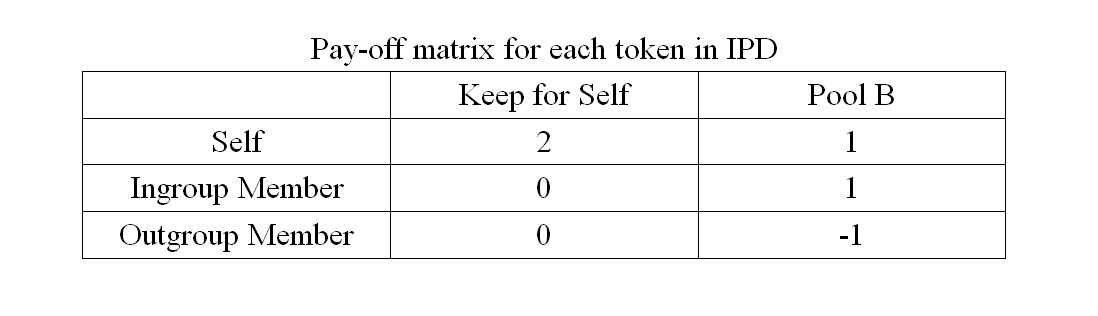
        Two types of economic games were introduced: the Intergroup Prisoner’s Dilemma game (IPD) and the Intergroup Prisoner’s Dilemma-Maximizing Difference game (IPD-MD). In the IPD game participants allocated tokens between a pool for themselves and a between-group pool (pool B). In the IPD-MD game participants allocated tokens among a pool for themselves, pool B and a within-group pool (pool W). As shown in the pay-off matrices below, a token allocated in pool B will benefit everyone in the group and harm the other group while a token allocated in pool W will benefit everyone in the group without harming the other group. The optimal strategy for individual would be keeping all tokens for themselves. In the IPD game, the optimal strategy for the group would be putting all tokens in pool B. However, if the other group do the same, both groups will gain nothing. In the IPD-MD game contributing to pool W makes a group gain without intergroup competition, but there is no guarantee the other group would do the same.
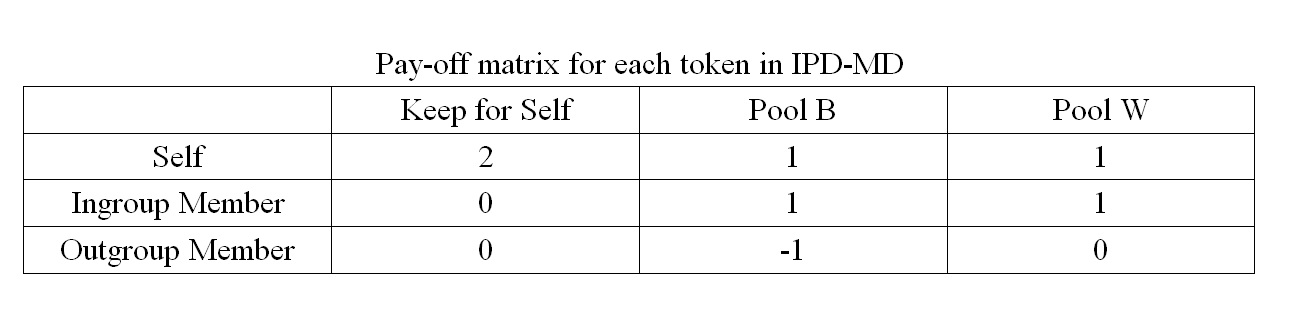
IPD-MD Payoff Matrix

IPD payoff matrix

1. What They Did – Intervention Summary:

       Participants were randomly assigned to two conditions. In the IPD-MD condition participants played IPD-MD game for 60 rounds. In the IPD condition participants played IPD game for 30 rounds and then IPD-MD game for another 30 rounds. All decisions were made in private using a computer. Participants played in a group of 3 against another group of 3.  Group composition and group matching were kept constant throughout the study. At the end of the study participants were paid for every points they earned.

 2. What They Found – Results:

       For the IPD-MD condition, as can be seen in the picture below, participants contributed on average 31.54% of their endowment to pool W, as compared with only 5.25% to pool B. The rest of the endowment (63.20%) was kept for private use. For the IPD condition, in the first (IPD) part of the interaction, the rate of contribution to pool B was 26.50%. In the second (IPD-MD) part, despite the competition in the first part, the contribution rate to pool B dropped to 5.72%. The present experiment established that out-group hate does not evolve spontaneously in interaction between randomly composed groups, not even after a period of intergroup conflict.

IPD

 3. Who Was Studied – Sample:

Undergraduate Students

 4. Study Name:

Halevy et al., 2012

 5. Citation:

Halevy, N., Weisel, O., & Bornstein, G. (2012). “In‐Group Love” and “Out‐Group Hate” in Repeated Interaction Between Groups. Journal of Behavioral Decision Making, 25(2), 188-195.

 6. Link:

http://www.econ.mpg.de/files/2012/staff/Weisel_JBDM_2011.pdf

 7. Intervention categories:

An opportunity to show ingroup love without outgroup hate

 8. Sample size:

144

 9. Central Reported Statistic:

In the IPD condition, a repeated measure ANOVA with block as a within-subject variable and contribution to pool B as the dependent variable found a highly significant block effect (F(3,33)=25.80, p<.001).

Read Ahead

Effect of Explanation on Understanding and Position Extremity

1. What They Did-Summary:

This study primarily focused on the effects that explaining one’s position on policy can have on feelings of understanding and position extremity.  198 participants were split into two groups.  One group was asked to rate their support or opposition to six different political policies such as instituting a flat tax or instituting a single-payer health care system.  Next, the participants were asked to rate their understanding of these policies.  Afterwards, they were asked to provide a mechanistic explanation for how two of these policies (chosen at random) work.  Lastly, the first group of participants were asked again to rate their position on and understanding of the issues.  The second group differed from the first in that they were only asked to rate their position on and understanding of the issues after they had provided an explanation of the policies.

The researchers predicted that people who hold extreme positions are under the illusion that they know more about policies than they really do.  Thereby, by having the participants explain how these policies work, they should realize this illusion of understanding and shift to a more moderate viewpoint.

2. What They Found-Results:

The researchers found a significant decrease in ratings of understanding following explanations.  They also found that people’s positions on the issues became significantly more moderate following explanations.  These findings confirmed the researchers’ predictions.

3. Who Was Studied-Sample:

198 U.S. residents recruited using MTurk, 52% male, 48% female.  40% Democrat, 20% Republican, 36% independent, 4% other.

4. Study Name:

Fernbach et al. 2013, Study 1.

5. Citation:

Fernbach, P.,  Rogers, T., Fox, C., and Sloman, S. “Political Extremism Is Supported by an Illusion of Understanding.” Psychological Science (2013): 1-8.

6. Link:

http://pss.sagepub.com/content/early/2013/04/24/0956797612464058

7. Intervention Categories:

mechanistic explanation, MTurk, judgment timing

8. Sample Size:

198

9. Central Reported Statistic:

Understanding: “This prediction was confirmed by a significant main effect of judgment timing: Postexplanation ratings of understanding (M = 3.45, SE = 0.12) were lower than preexplanation ratings (M = 3.82, SE = 0.11), F(1, 197) = 34.69, p < .001, ηp2 = .15.”

Position Extremity: “This prediction was confirmed, with the main effect of judgment timing significant (preexplanation-rating conditions: M = 1.41, SE = 0.07; postexplanation-rating conditions: M = 1.28, SE = 0.08), F(1, 86) = 6.10, p = .016, ηp2 = .066.”

10. Effect Size:

Understanding: t(5) = 5.74, p < .01.

Position Extremity: t(5) = 3.93, p = .011.

Read Ahead

Political Discrimination as Normative as Racial Divisions once were

Once upon a time, it was socially normative for society to divide itself along racial lines.  Thankfully, that time has passed and while racism still exists, it is generally considered to be a bad thing by most people in society.  The same trajectory is occurring with respect to attitudes toward homosexuals, with increased acceptance being not only encouraged, but mandated as the right thing to do.  However, in many circles, it remains normative for individuals to discriminate against those with the opposite political views.  Recent research indicates that this occurs amongst both parties.

Despite ample research linking conservatism to discrimination and liberalism to tolerance, both groups may discriminate. In two studies, we investigated whether conservatives and liberals support discrimination against value violators, and whether liberals’ and conservatives’ values distinctly affect discrimination. Results demonstrated that liberals and conservatives supported discrimination against ideologically dissimilar groups, an effect mediated by perceptions of value violations. Liberals were more likely than conservatives to espouse egalitarianism and universalism, which attenuated their discrimination; whereas the conservatives’ value of traditionalism predicted more discrimination, and their value of self-reliance predicted less discrimination. This suggests liberals and conservatives are equally likely to discriminate against value violators, but liberal values may ameliorate discrimination more than conservative values.

In addition, recent research out of Stanford University indicates that “hostile feelings for the opposing party are ingrained or automatic in voters’ minds, and that affective polarization based on party is just as strong as polarization based on race.”  Tackling this at the societal level is a daunting task for anyone, but there are things that one can do at the individual level.  Both research and practice indicates that positive relationships between individuals across such divides are likely to ameliorate such feelings.  Mixing group boundaries are likely to make competition less salient as well, perhaps allowing superordinate goals that we all share to come to the fore, as often happens when national emergencies strike.  Just as with discrimination based on race and sexual orientation, discrimination against opposing ideologies can be combated with similar techniques.

– Ravi Iyer


Read Ahead

When Morality Threatens Civility

Politics is fundamentally a group phenomenon that should be examined in relation to person’s identification with a particular group label (see Allport, 1954). When a person identifies as a “conservative” or “liberal” it means that he or she not only assumes a particular set of political positions but also identifies with other partisans as well as the shared sense of reality implied therein (Devine, 2014; see also Jost, Ledgerwood, & Hardin, 2008). To define oneself in this way often implies the identification of opponents, rivals or even enemies (cf. Edelman, 1988) that, at increasing levels, becomes a means of further clarifying what it means to be a “conservative” or a “liberal.”

“Civility,” which is the concern of this group, should therefore be examined as an intergroup, rather than interpersonal matter. What, then, does research on intergroup relations have to say about increasing civility among political partisans? I would argue that the greatest threat to political civility within a stable democracy is the “moralizing” of political discourse as it pertains to political groups. Namely, it is one thing to view your political opponent as misguided or simply wrong; it is another thing entirely to view him/her and the group that he/she represents as immoral, transgressive, or just plain evil. When placed in the latter realm, political discourse becomes decidedly less civil as the concept of “loyal opposition” becomes not only oxymoronic, but tantamount to treason.

When Morality Threatens Civility

Why must we as social scientists, practitioners, and scholars be wary when political discourse becomes moralized? The simple answer is that morality is powerful. The capacity for moral judgment and moral action may be encoded into our very fiber as a species and may have been the building blocks upon which human civilization was founded (Haidt, 2007, 2012; Greene, 2013). Putting aside the ontology of human morality, a much more parsimonious reason, at least for my purposes, for why morality is powerful is that people tend to view moral values as being objectively true (Goodwin & Darley, 2008). That is, a moral statement (e.g., “It is wrong to kill.”) is perceived to be more like an empirically verifiable fact (e.g., “The Earth revolves around the Sun.”) and less like a statement of social convention (e.g., “An appropriate tip for your server is 15 to 20 percent of the bill.”).

And there’s the rub, so to speak. A person’s morality is rooted in beliefs that are perceived to be as true as the Earth revolves around the Sun and which also imply a proscriptive element: not only is it wrong to kill, but one ought not to kill. A person’s moral worldview not only describes social reality but also guides future behavior as well as how future behavior is to be evaluated. One only needs to consult the work of Linda Skitka on moral conviction (see Skitka, 2010) or Jeremy Ginges’ work on sacred values (e.g., Atran & Ginges, 2012; Ginges & Atran, 2011) to see how these aspects of morality function in politics. What their work demonstrates is that we often judge the actions of others in relation to whether they reflect or confirm our moral values, even if violates considerations of procedural justice (Skitka & Houston, 2001) or our own utilitarian benefit (Ginges & Atran, 2011).

The “moralizing” of intergroup relations is often reflected in the attribution of moral or immoral qualities to other groups. I am currently examining the consequences of this process as part of my dissertation. In my preliminary findings (see Pilecki et al., 2013), I have found that when people perceive that members of another group (e.g., liberals, conservatives, feminists, evangelicals, etc.) as being typically less moral than most other people they are more likely to view violence or acts of political repression towards that group as being appropriate. These findings reinforce previous empirical and theoretical work by Susan Opotow (1990, 1993, 1994) and others (e.g., Bar-Tal, 1990) on the “scope of justice,” which refers to the distinction that people make between those considered worthy of moral treatment and those considered unworthy of moral treatment. When a social group is imbued with immoral qualities by political leaders, pundits, or other “entrepreneurs of identity” (Reicher & Hopkins, 2001) that group is effectively set apart from others and, in effect, becomes a legitimate and morally justifiable target of harm rather than civil discussion.

When people moralize intergroup relations they limit the potential for civil discourse to emerge as they frame political issues within the realm of sacred values, thereby making trade-offs and compromises less likely (Tetlock, 2003; Tetlock, Kristel, Elson, Green & Lerner, 2000). The words and labels we use to describe the social groups with which we identify and those that we oppose shape how we think about us, them and how we relate to one another (see Hammack & Pilecki, 2012). In other words, language matters and it is therefore incumbent for social scientists and practitioners to hold political leaders, media figures and other influential people accountable for their use of moralizing rhetoric to mobilize support, gain more viewers, and/or delegitimize criticism.

Read Ahead
Our goal is to educate the public about social science research on improving inter-group relations across moral divides.