For those of you looking for a break from the everyday partisanship that characterizes this election season, you can catch Civil Politics on 2 recent radio shows/podcasts.
Professor Matt Motyl and Liz Joyner of the Village Square were recently on this episode of Science Friday. What was notable for me in this episode were some of the stories that dovetailed well with our recommendations, such as an elected Democrat in rural conservative Wisconsin who go to where she was by making friends with people first, rather than starting with politics.
I also had the pleasure of being interviewed for Peace Talks Radio (listen here), where I was able to convey many of the same messages that we relate on this website regarding the importance of relationships and of moving away from competitive inter-group dynamics.
As political events in Europe and America got stranger and more violent over the last year, I found myself thinking of the phrase “things fall apart; the center cannot hold.” I didn’t know its origin so I looked it up, found the poem The Second Coming, by W. B. Yeats, and found a great deal of wisdom. Yeats wrote it in 1919, just after the First World War and at the beginning of the Irish War of Independence.
Here is the first stanza:
Turning and turning in the widening gyre
The falcon cannot hear the falconer;
Things fall apart; the centre cannot hold;
Mere anarchy is loosed upon the world,
The blood-dimmed tide is loosed, and everywhere
The ceremony of innocence is drowned;
The best lack all conviction, while the worst
Are full of passionate intensity.
The last two lines point to moral psychology—people full of passionate intensity—as one of the reasons why things fall apart and the centre cannot hold. This analysis fits with many books written about the causes of political violence and genocide (see Baumeister; Fiske & Rai; and my book, The Righteous Mind). It also fits my analysis of why things are falling apart on American college campuses.
I therefore used the poem as the leitmotif of a talk I gave last week at the American Psychological Association’s annual convention, in Denver, where I offered my most complete statement ever on the causes and consequences of political polarization. I focused on the causes of America’s political dysfunction and then extended the analysis to Europe as well. Something is going wrong in Western liberal democracies; there is something we’re not understanding.
But as long as I had the opportunity to address the largest gathering of psychologists in the world, I wanted to extend the analysis to psychology too. I showed how we, as a field, have gotten politically polarized, as with so many other academic disciplines, professions, and institutions. We have become part of the problem, and it is damaging our science and our ability to help our clients, patients, and students. I proposed that we must fix ourselves before we can become part of the solution.
Here is the entire talk (54 minutes), including an introduction from Susan McDaniel, the president of APA.
I hope that the talk will be useful in high school and college courses on civics, political science, and social psychology. I am therefore posting the slides, both as a PowerPoint file and as a 12 page PDF file. (I encourage their use by educators at all levels.)
I also hope that the talk will help people to understand our mission here at Heterodox Academy. Polarization and political purification are happening to so many institutions. For institutions that aim to discover truth, such as a university, ideological purification is deadly. Pleasing but false ideas go unchallenged. Unpleasant but true ideas don’t get a hearing. Until we figure out ways to increase viewpoint diversity and to end the intimidation and ostracism experienced by those who question orthodoxy on campus, universities will be part of our national problem, not part of the solution.
When bad things happen, there is a natural psychological tendency to spread blame around. Consider this piece of psychological research from Joshua Knobe where he shows that when someone causes harm to the environment, they are deemed to be doing so intentionally, whereas when they cause benefit to the environment, they don’t get the same credit. Unfortunately, we often blame not only people who are directly responsible for a bad event, but members of the “groups” that people involved belong to.
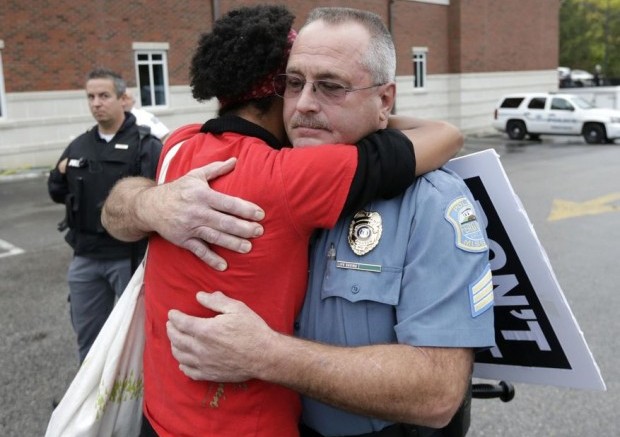
Consider these reactions to recent shootings of both officers in Dallas and civilians by officers.
Fortunately, both of the above reactions are rare and most people realize that it is possible to sympathize with both the police and the minorities who have been killed in recent events.
According to Dallas police, protesters helped capture the shooters. And cops helped shuttle protesters to safety during the attack.
For those of us seeking to understand people’s reactions to events better, with an eye toward defusing conflict, this paper on “Vicarious Retribution” (full text here) provides a good model, bringing together a variety of research, of how such conflict perpetuates itself and how such conflict can be reduced. Let me highlight 2 passages from this paper that recommend specific ideas for those who want to intentionally reduce the potential for conflict.
Focus on Feelings of Sympathy for victims:
The final emotion that may be relevant for defusing cycles of retributive aggression is sympathy. Some research suggests that focusing on the harm that has befallen the outgroup (rather than the bad acts of one’s ingroup) elicits feelings of sympathy rather than guilt and that sympathy has a stronger relationship with changing the system of intergroup relations to avoid against future conflict than does guilt (Iyer et al., 2003).
Highlight the individuality of cops and minorities:
The first process that should be initiated (according to Pettigrew, 1998) is decategorization. This approach involves reducing or eliminating social categorization by increasing differentiation and personalization between group members (Brewer & Miller, 1984; Ensari & Miller, 2001; N. Miller, 2002). From our perspective, decategorization (particularly if it is in the form of personalization) is indeed an important first step in breaking the cycle of vicarious retribution.
As with much of what we have found evidence for in reducing inter-ideological divisions, it often comes down to finding common goals (e.g. sympathizing with the families affected by all of the recent shootings and preventing further tragedy) and building personal relationships with others who we might be tempted to stereotype. Whether you are more naturally inclined to identify more with minority groups or police officers, the current moment is a time when people on either side of the issue can sympathize with those who have lost their lives recently and work together on our collective desire for a safer, less divided country.
I haven’t written much about Trump, who has taken “incivility” to new heights this election season, in part because there is no evidence that telling large groups of people to be more civil has any value. There is both anecdotal evidence and research that suggests forcefully telling people to be more civil will backfire. Incivility and conflict involving large groups of people tends to be a function of a situational dynamic – two groups competing for a goal or a scarce resource like victory in a game or an election – that trumps any direct commandment to be more civil. The rise of Trump as a political force is an opportunity for us to practice what we preach at Civil Politics and try to understand the dynamics that give rise to the conflict we see, in the hopes of cutting it off at its source. As has been written in other places, Trump is a symptom, not a cause, and we are likely to see others follow in his footsteps whether he is elected or not. If we really want a better political dialogue, we need to understand the root causes of Trump’s appeal.
It helps to start with the empirical fact that there are very few truly evil people in the world. Human beings are uniquely social creatures who survived and thrived by being able to cooperate with hundreds of thousands of others, such that only ~1% of us are “psychopaths” who actually don’t care about others. A human being who doesn’t care about others is akin to a bee that doesn’t care about his hive. It’s rare. The rest of us really do care about others beyond ourselves and try to do what we think is right, even if we sometimes do what others would think of as “evil” as a result. That definition of “right” may include violence, theft, and incivility in the name of a moral cause (see research on idealistic evil, the dark side of moral conviction or terrorism and sacred values), but there is a moral cause behind most people’s actions, even when we disagree with those actions.
Trump supporters have many moral motivations that many who disagree with him would recognize and value.
– They worry about the lack of jobs for hard-working, but under educated Americans.
– They fear that the system of lobbyists and special interests is stacked against them.
– They think that politicians cannot be trusted to fight for everyday Americans, due to their reliance on donors who line their pockets.
– They feel that their identity and their ability to express their opinions is under attack.
Indeed, many of these positions are emphasized by Bernie Sanders, which is why you sometimes see people who support Trump and Sanders both. Calling Trump supporters racist, stupid or naive is not only a misleading caricature, but also a recipe for only exacerbating the coarsening conflict that we are trying to avoid, as it drives each side into its corner. If we want things to get better, research suggests that we have to start from a place of common goals and develop a positive relationship with Trump fans rather than having convincing them why they are wrong as our ultimate goal. Staging violent protests at Trump’s rallys is the opposite of this. How can we instead reduce the divisions, rather than inflame them?
Let us acknowledge that we need to do something to help people who want to work hard but are being left behind by an increasingly global and technological economy. Let us acknowledge that lobbyists and donors have undue influence and work to curb that influence, whether it be through campaign finance or a simpler government with fewer rules to be gamed. Let us all accept that we want a society where no identity, American or immigrant, religious or atheist, urban or rural, feels threatened and unable to express their opinions freely, and work to make relationships across these divides. And let us accept that whatever we think of Donald Trump as a person, his supporters are generally ordinary Americans who care deeply about their kids and their communities. Let’s help them with their concerns as it makes no sense to be someone who cares deeply about poor Americans who simultaneously denigrates many in that group, who happen to support a candidate they disagree with.
To be clear, I do not support Trump or his rhetoric which is deeply uncivil and divisive. But those who are demonizing Trump’s supporters and disrupting his events are only exacerbating the problem. As Martin Luther King Jr. once said, “Hate cannot drive out hate: only love can do that” and there is ample research that suggests that forging positive empathic relationships across divisions is indeed the only way to truly heal a great moral divide.
– Ravi Iyer
Ravi Iyer has a Ph.D in psychology from the University of Southern California and has published dozens of articles on political and moral attitudes. He works as a data scientist at Ranker and is also the Executive Director of Civil Politics, a non-profit that promotes evidence based methods for healing inter-group divisions.


 Professor Matt Motyl and Liz Joyner of the Village Square were recently on this episode of Science Friday. What was notable for me in this episode were some of the stories that dovetailed well with our recommendations, such as an elected Democrat in rural conservative Wisconsin who go to where she was by making friends with people first, rather than starting with politics.