Educating the Public on Evidence-based methods for improving inter-group civility.

Bridging the Divide between Sensitivity to Minorities and Free Speech

While we often study issues related to bridging divisions between liberals and conservatives, there are many issues that aren’t quite as clear cut. We recently studied an event put on by The Village Square concerning the tension between sensitivity to minorities on campus, which sometimes involve limits on what people can express, versus the principle of free speech. Recent controversies at universities like Claremont Mckenna, Yale, and the University of Missouri have highlighted these tensions, with liberals tending to be more in favor of protecting minorities, but also often pitting liberals against fellow liberals.

At the beginning of the event, the liberal leaning audience was indeed more implicitly inclined toward people who want to err on the side of sensitivity toward minorities, feeling that such people were more likely to be good people who they would want to be friends with.  Knowing this, the organizers of the event were able to recruit a free speech advocate who argued their point from a liberal perspective. From the Village Square’s description of their event.

For our Free Speech program we started with a liberal local Rabbi as facilitator who had a very positive relationship with an African American community leader who is beloved locally – and who until recently was a Republican. We knew that Mr. Hobbs had some empathy for both the need to protect minorities and the value of free speech. To complete the panel, we invited Jonathan Rauch of Brookings Institute, who saw the danger of the anti-free speech trends on campus earlier than anyone, originally publishing “Kindly Inquisitors: The New Attacks on Free Thought” in 1993. Rauch argues that the protection of free speech actually protects and advances the cause of minority students – so he makes a liberal argument for a more classically conservative value. Another quality we liked for our panel is that he’s Jewish, so it gave him something deeply in common with our facilitator (to balance the existing positive relationship between the facilitator and Mr. Hobbs). This very high level of pre-existing empathy and cross-cutting relationships made this program quite easy compared to our usual programs, as well as especially enjoyable – though lacked as much tension as some programs do.

We always arrange a meeting between panelists ahead of the program. This gives them the opportunity to break bread together and bond as human beings, by the time they’re on stage they feel to all like friends. As we met for breakfast the morning of the program, when one panelist shushed me up because he wanted to hear more details from the other panelists about something, I sat back and said to our facilitator “my work here is done.” We call this whole process leading up to whoever is on our stage as choreography. We think it is central in delivering results. By the time the program begins, much of the fate of the program is “baked in.” In fact, one could reverse these principles to engineer a disaster, or pay no attention to them and throw the results out to luck.

Following exposure to Mr. Rauch and the generally friendly discussion between people on opposite sides of the issue, the liberal audience’s opinions about those who emphasize free speech rose to be comparable to opinions about those who emphasize sensitivity to minorities (see the below graph for a pre vs post event comparison).
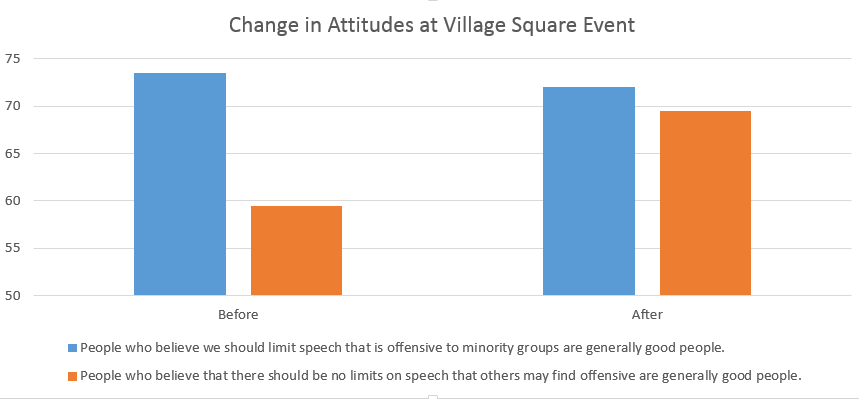
Free Speech vs. Sensitivity to Minorities Event Results

As we have found in previous studies of events, there was little change in people’s attitudes about the issue.  The generally liberal audience did not feel any differently about protecting minorities or free speech.  However, they did feel differently about those who they may disagree with.  It is this difference that enables people who disagree about issues to work together, and if we can get more friendly conversations across this divide, and get people out of their moral communities, then perhaps we can avoid a repeat of some of the ugly scenes we have seen on college campuses between two groups of people who both have genuinely good intentions.

– Ravi Iyer
Read Ahead

Helping People Sympathize with both Cops and Minorities

When bad things happen, there is a natural psychological tendency to spread blame around.  Consider this piece of psychological research from Joshua Knobe where he shows that when someone causes harm to the environment, they are deemed to be doing so intentionally, whereas when they cause benefit to the environment, they don’t get the same credit.  Unfortunately, we often blame not only people who are directly responsible for a bad event, but members of the “groups” that people involved belong to.

Consider these reactions to recent shootings of both officers in Dallas and civilians by officers.


Fortunately, both of the above reactions are rare and most people realize that it is possible to sympathize with both the police and the minorities who have been killed in recent events.


For those of us seeking to understand people’s reactions to events better, with an eye toward defusing conflict, this paper on “Vicarious Retribution” (full text here) provides a good model, bringing together a variety of research, of how such conflict perpetuates itself and how such conflict can be reduced.  Let me highlight 2 passages from this paper that recommend specific ideas for those who want to intentionally reduce the potential for conflict.

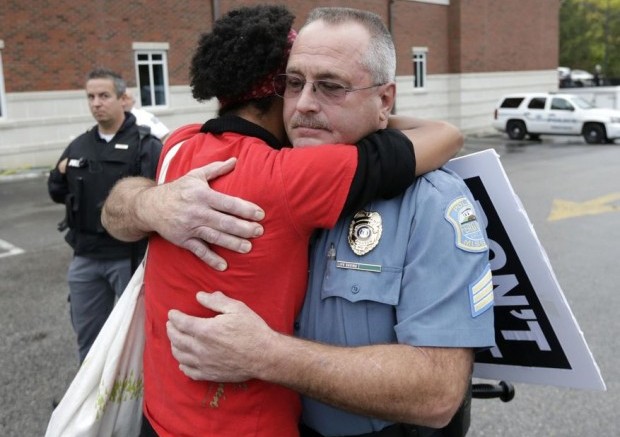
copshugprotestors


Focus on Feelings of Sympathy for victims:

The final emotion that may be relevant for defusing cycles of retributive aggression is sympathy. Some research suggests that focusing on the harm that has befallen the outgroup (rather than the bad acts of one’s ingroup) elicits feelings of sympathy rather than guilt and that sympathy has a stronger relationship with changing the system of intergroup relations to avoid against future conflict than does guilt (Iyer et al., 2003).

Highlight the individuality of cops and minorities:

The first process that should be initiated (according to Pettigrew, 1998) is decategorization. This approach involves reducing or eliminating social categorization by increasing differentiation and personalization between group members (Brewer & Miller, 1984; Ensari & Miller, 2001; N. Miller, 2002). From our perspective, decategorization (particularly if it is in the form of personalization) is indeed an important first step in breaking the cycle of vicarious retribution.

As with much of what we have found evidence for in reducing inter-ideological divisions, it often comes down to finding common goals (e.g. sympathizing with the families affected by all of the recent shootings and preventing further tragedy) and building personal relationships with others who we might be tempted to stereotype.  Whether you are more naturally inclined to identify more with minority groups or police officers, the current moment is a time when people on either side of the issue can sympathize with those who have lost their lives recently and work together on our collective desire for a safer, less divided country.

– Ravi Iyer

Read Ahead

Bridging the Divide Between Religious Liberty and Marriage Equality

I was recently invited to a small gathering of individuals on both sides of the marriage equality vs. religious liberty debate. These issues aren’t necessarily inter-twined, but there have been several high profile cases where homosexuals who were getting married and wanted to be treated equally by businesses in their community have run into business owners who feel that it is a violation of their religious freedom to be forced to facilitate gay marriages. This divide, between those who advocate for marriage equality and those who advocate for religious freedom, has been at the center of numerous recent state law controversies, with the governor of Georgia vetoing legislation that would have emphasized religious freedom while states like Mississippi and Indiana having passed such legislation.

The takeaway I got from the meeting was that the debate need not be so polarized, and that when good people on both sides of the debate are put into the same room (and there are good people on both sides), they naturally become sensitive to the sincere concerns of others about how they felt in being denied service or having their faith-based motives questioned.  There are many advocates of gay marriage who care deeply about faith and want to be respectful of those who are religious.  And there are many advocates of religious freedom who care deeply about the feelings of homosexuals.  As is suggested in our research, when the debate becomes less about abstract policies and more about finding a way to compromise with people you have spent time with and gotten to know at a personal level, common ground is possible.

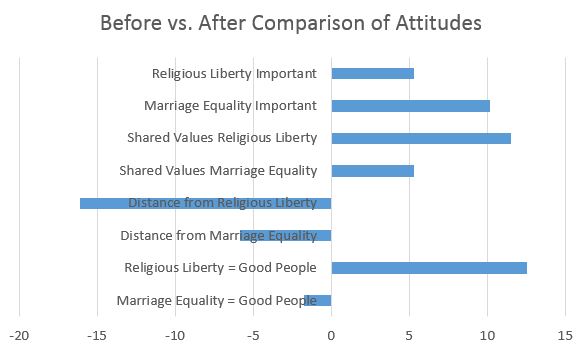
This was certainly our experience of the event, but we also have data to this effect.  We were lucky enough to have been invited to survey participants about their feelings before and after the event, concerning people who they agreed with or disagreed with in the context of this debate.  The below chart shows change in agreement to various statements, with positive values indicating more agreement after the event and negative values indicating less agreement.  As you can see in the chart below, after the event, people came away feeling that both issues were more important, that they shared values more with people of the other side, and that they felt less social distance (more willingness to be friends) toward both groups.  There was also more feeling that religious liberty advocates tend to be good people, though little change in attitudes toward advocates of gay marriage, as participants actually came in with surprisingly consistently positive attitudes toward this group already, leaving little room for improvement.  That could be something more general or something specific to this group that was willing to meet, which perhaps did not include the most extreme individuals in each camp.  Still, overall, while the sample size is not big enough for a traditional academic study, there was certainly a self-reported shift amongst a number of people as a result of such a meeting, which was also echoed explicitly by comments by people in the room after the event..

marriage_equality_vs_religious_liberty2
Positive scores indicate greater agreement after the event. Negative scores indicate more disagreement after the event.

“Good People” indicates agreement that people who XXX are good people.  “Distance From” indicates agreement that If I found out that a coworker was XXX, I would be less likely to be friends with them. “Important” indicates agreement that XXX is an important issue that we should work together to address. “Shared Values” indicates agreement that people who are XXX have many of the same values as I do.   

Our experience of this event dovetails well with what most people know as common sense. Rarely are people convinced by facts as to the error of their opinions. There are good people on both sides of the gay marriage/religious liberty debate and they would do well to get to know each other better, as when people on opposite sides get to know each other first, they produce less polarization….and the potential for policies that respect both groups.

– Ravi Iyer

Read Ahead

The Village Square Helps Liberals Understand that Conservatives are indeed Good People Too

One of the things that we do at Civil Politics is help organizations conduct program evaluations as part of an effort to understand how the academic research that is largely produced in university settings translates to the real world.   We recently studied an event put on by the Village Square on January 12th entitled Created Equal + Breathing Free, where the ostensibly liberal virtue of diversity was discussed alongside the ostensibly conservative issue of  allowing religious liberty.  The event mirrors ideas from academia that suggest that positive contact between groups can lead to better relationships, especially when the groups collaborate on shared goals (e.g. recognizing a concern that each side brings to the table).

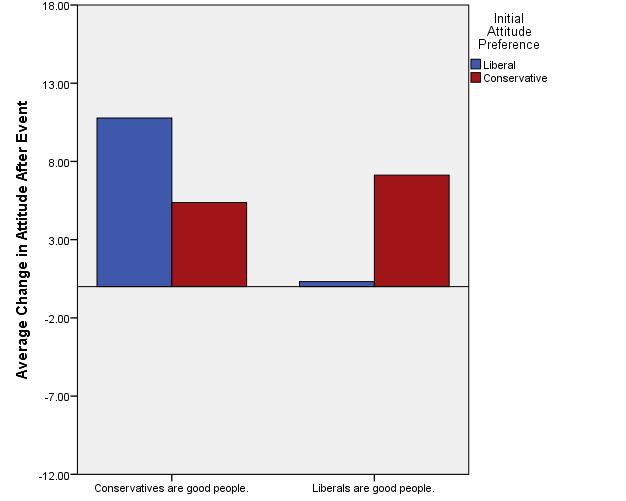
To that end, we asked people who attended the event to agree or disagree with statements about the importance of diversity, the importance of religious liberty, and attitudes toward liberals and conservatives.  We asked the same questions before and after the event, to see if the event changed any attitudes and, as we have found before in such work, we found that people’s attitudes about issues are hard to change, but that people do end up liking people in the opposing group more after the event.  The below graph shows that attitudes toward all groups increased post-event, with the highest increases amongst those who came into the event with pro-liberal attitudes becoming significantly more likely to believe that “conservatives are good people” (see leftmost bar in the below graph).

villagesquare event graph Jan 20161

37 people ended up completing both before and after event surveys and there was one statistically significant finding – that people were more likely to agree with the statement “conservatives are good people” after the event, as compared to before the event (+ 7.35 on a 100 point scale, t-test t=2.392, p = .022).  This was driven almost entirely by the 22 people who started the event with more agreement to the idea that liberals are indeed good people, as compared to the idea that conservatives are good people (the increase was 10.8 points amongst this group), suggesting that the main effect of the event was to convince a generally liberal audience that conservatives are indeed good people too.

Note that the event didn’t change anyone’s mind as to the importance of the issues or make either group want to be friends with the other.  The event organizers predicted as much from their experience of the event.  But perhaps the simple belief that those who one disagrees with are indeed good sincere people is a step in the right direction for a single night’s work, and for that, we thank the Village Square and anyone who brings people together in their communities in the spirit of collaboration across groups.  In our experience, change often happens one relationship at a time.

– Ravi Iyer

ps.  If you’re interested in the Village Square’s take on these results, you can read more about their philosophy and their experience of the event here.

Read Ahead
Our goal is to educate the public about social science research on improving inter-group relations across moral divides.